Coimbra Airport Transfers
Coimbra, the university city on the River Mondego in central Portugal, has no airport of its own, so every arrival is a transfer of some kind. This guide covers the real options: which airport to fly into, how the two confusingly named train stations work, what the city's own verified prices are, and where the common advice goes wrong.

Short answer
Coimbra, Portugal has no airport. Most visitors fly into Porto or Lisbon and arrive by train, with Coimbra-B and Coimbra-A the two stations to know. A pre-booked private transfer meets you at the airport; otherwise the CP train plus a short city connection is the standard route. The tourist tax is 1.00 EUR per night, capped at three nights.
Coimbra, the university city on the River Mondego in central Portugal, has no airport of its own, and that single fact shapes every arrival plan. There is no taxi rank outside a Coimbra terminal because there is no terminal. Every visitor lands somewhere else, usually Porto or Lisbon, and completes the journey by train, coach, rental car or pre-booked private transfer. This guide, from the editorial desk at Coimbra Travel Guide, walks through each option in the order a traveller actually meets them: choosing the airport, understanding the two stations, crossing the city, and reaching the hotel door. Where a figure is verified from an official source it is printed; where the honest answer is that the operator's own site is the only reliable place to check, it says exactly that.
Which Airport Should You Fly Into for Coimbra, Portugal?
Coimbra has no airport of its own, so the choice is between Porto (OPO) and Lisbon (LIS), and the honest answer is that the airport with the better flight price and schedule usually wins, because both cities connect to Coimbra by rail from their main stations. Neither airport sits in Coimbra, and neither has a dedicated Coimbra shuttle. The train is the standard onward leg from either, and the operator to check for times and fares is CP, Comboios de Portugal.
The decision therefore works backwards from the rail connection rather than forwards from the flight. Both Porto and Lisbon are served by the long-distance networks that stop in Coimbra, and both airports link to their city's main rail stations by metro. What this site cannot print, and will not, is a road distance or a driving time from either airport to Coimbra: those figures circulate widely in guides, but none was verified from an official source on this build, and a distance-calculator website is not a source this site accepts. The practical comparison is about schedules, fare deals and where your onward day-trips sit, not a number of kilometres.
A useful tiebreaker is the rest of the itinerary. Travellers pairing Coimbra with the Atlantic coast or a day trip from Porto often prefer flying into Porto; those combining it with Lisbon and the south usually fly into Lisbon and follow the Lisbon to Coimbra rail line north. If Coimbra is one stop inside a wider Centre-region plan, read the Coimbra travel guide overview before committing.

How Do the Two Coimbra Train Stations Work?
Coimbra has two railway stations with confusingly similar names, Coimbra-B and Coimbra-A, and they are in different places: Coimbra-B sits on the edge of the city on the long-distance line, while Coimbra-A is the station closest to the historic centre. Which one your train calls at depends on the service, and the only reliable place to check the stopping pattern is CP, Comboios de Portugal, whose passenger site publishes the timetables. Do not rely on a guide for this, including this one.
The reason for that blunt final sentence is a build-level lesson. When this site's research pass tried to verify which trains call at which Coimbra station, CP's website returned HTTP 200 status codes for station pages whose actual content read "Page not found". The server replied, but the page did not exist. Every confident statement in circulation about which station serves which train, and above all about whether the short shuttle between the two is free with a long-distance ticket, rests on exactly the kind of page that failed that check. So: two stations, different locations, and CP's own passenger site for the specifics. That is the verified position, and the full breakdown lives in Coimbra train stations A and B.
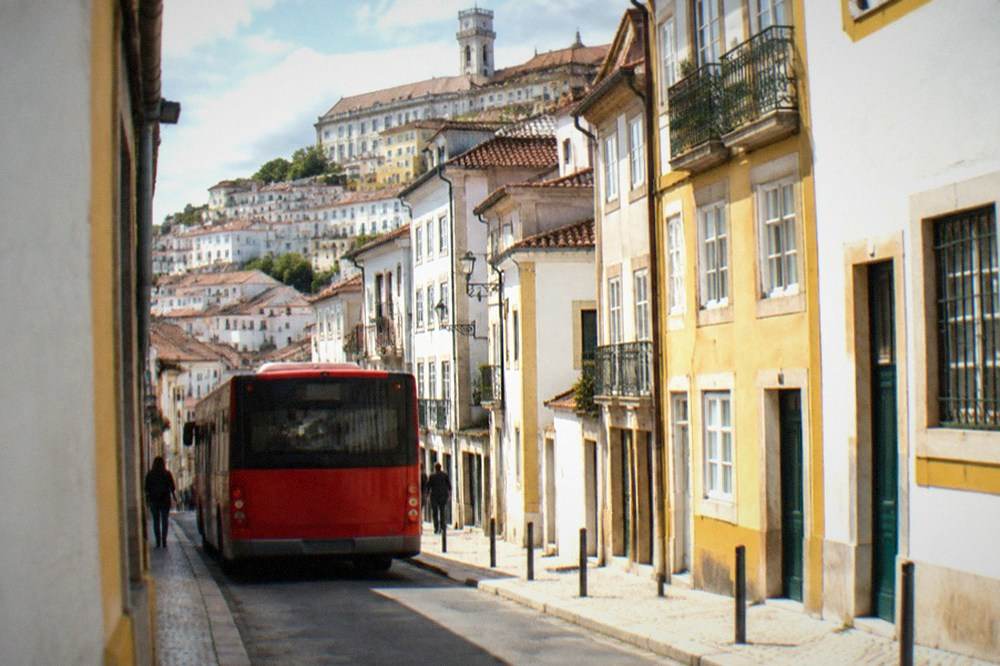
What can be said with confidence is the practical shape of arrival. Long-distance passengers stepping off at the station on the city's edge will need one more short leg, whether that is the shuttle, an urban bus or a taxi, to reach the old town, and the station nearer the centre puts you within reach of the Baixa on foot or a short ride. Build that final leg into the plan rather than assuming the train delivers you to the hotel door.
Is a Private Transfer from the Airport Worth Booking?
A private airport transfer is worth booking when arrival time matters more than cost: late-night landings, travel with small children, heavy luggage, or a tight connection into a pre-booked Joanina Library time slot all argue for a driver who meets you in the arrivals hall. On price alone it never wins against the train. On certainty it always does, because a pre-booked driver removes the station question, the shuttle question and the city-crossing question in one transaction.
The Joanina point is not decorative. The University of Coimbra's own visit pages state that entry to the Biblioteca Joanina is limited to 50 people every 20 minutes, that the time printed on the ticket is the fixed library slot, and that visitors outside their printed slot are refused. A missed connection does not merely delay a sightseeing day; it can void the single most sought-after ticket in the city. Anyone whose plan chains a flight into a timed Joanina entry should read Joanina Library tickets and University of Coimbra tickets before deciding how much slack the transfer needs.
For everyone else, the honest hierarchy is simple. The train is the default. A transfer is insurance. A rental car is a third thing entirely, covered below, and only worth it when Coimbra is a base for the Schist Villages, Buçaco or the Bairrada wine country rather than a city stay.
How do You Cross Coimbra Once You Have Arrived?
Coimbra's city transport is run by SMTUC, whose 2026 tariff lists a driver-bought single at 2.00 EUR and pre-purchased trips at 0.90 EUR each when bought in packs of three or more, with one ticket valid 90 minutes on the urban network including transfers. The same tariff states that SMTUC tickets are also valid on the Metro Mondego network, the new bus-rapid system opening in stages across the city, so a bus ticket is also a metrobus ticket.
That last clause is the detail almost no guide has, because it comes from reading the operator's own tariff document rather than summarising a blog. The tariff's intermodal section is explicitly headed for use on both SMTUC and Metro Mondego, and it is in force from 1 April 2026. The Metro Mondego system has been opening in stages, with dated Portuguese press describing extensions reaching Coimbra-B station and Praça da República in late summer 2026, but the operator's own site refused this build's automated checks, so route-by-route detail is not printed here. What is safe to say: your SMTUC ticket works on it, and the network is growing.
| SMTUC ticket type | Price | Notes from the 2026 tariff |
|---|---|---|
| Single, bought from the driver | 2.00 EUR | Valid 90 minutes on the urban network |
| Pre-purchased, packs of 3+ trips | 0.90 EUR per trip | Loaded on a rechargeable card |
| Viagem ConVIDA support card | 0.50 EUR | Card for occasional and pre-purchased tickets |
| Large-family 1-day ticket, 7 trips | 1.00 EUR | Requires the family card |
| MOVE-C support card | 3.00 EUR youth / 6.00 EUR others | Youth and standard card prices |
Two practical warnings about crossing the city. First, Coimbra is a city of hills: the university sits high above the river and the walk up from the Baixa is steep, which is why the Elevador do Mercado exists. Second, the tariff lists a fare-evasion fine of 120.00 to 350.00 EUR, so validating the ticket matters even on a short hop. The full picture, including the funicular and the metrobus, is in getting around Coimbra.
What Will Arrival in Coimbra Actually Cost?
The verified arrival cost is the tourist tax, at 1.00 EUR per guest per overnight stay, capped at three consecutive nights and payable to the accommodation from age 16, plus your rail or transfer fare. The municipality's own worked example: a couple staying seven nights pays 3.00 EUR each, 6.00 EUR total, at check-in or check-out. A two-euro rate was approved as a proposal in July 2026 but is not the published current rate, so budget one euro per night.
The tax is in force since 5 April 2023, applies all year with no low-season exclusion, and carries no VAT. Exemptions exist for medical stays, one companion of a medical traveller, and guests with a disability of 60% or more, on production of a document. There is no exemption for business travel, internships, students or research fellows, which catches out visiting academics expecting a waiver.
Why the tax exists is worth knowing, because the municipality publishes the arithmetic. Coimbra recorded 698,151 overnight stays in 2025, the municipality's own figure for the municipality, and its study puts the annual municipal cost associated with tourism at 2.44 million EUR, or 3.49 EUR per overnight stay. The one-euro tax sits below cost, which is the stated justification for the two-euro proposal. Almost no competing guide carries these numbers, and they come from the municipality's own economic report rather than an estimate.
| Arrival cost item | Verified amount | Source |
|---|---|---|
| Tourist tax, per guest per night | 1.00 EUR | Municipal tax page, in force since April 2023 |
| Tourist tax cap | 3 consecutive nights | Municipality's worked example |
| Tax minimum age | 16 (birthday excluded) | Municipal tax page |
| Municipal cost per overnight stay | 3.49 EUR | Municipality's 2025 tourism cost study |
| Overnight stays recorded in 2025 | 698,151 | Municipality's own figure |

Should You Rent a Car at the Airport for Coimbra?
A rental car makes sense if Coimbra is a base for the region, the Schist Villages of the Lousã, the Buçaco forest, the Bairrada wine route or Conímbriga, and less sense if the stay is city-only, because the old town is steep, partly pedestrian, and better crossed on foot or by the city's own transport. The decision is about the day trips, not the transfer. Coimbra's airport leg is a train journey either way.
The city-only case is strong. The main sights cluster on the university hill and in the Baixa below it, and the standard first-day route, Paço das Escolas, the Biblioteca Joanina, Sé Velha, Mosteiro de Santa Cruz, is a walking itinerary, not a driving one. Parking in the historic centre is its own project, covered in the parking guide, and the car rental page covers where picking a car up actually suits the itinerary.
The regional case is just as strong, and it is where the car earns its keep. The Schist Villages, Buçaco, the Bairrada and Conímbriga are the four classic escapes, and each has its own guide on this site: Schist Villages, Buçaco forest, the Bairrada wine route and Conímbriga Roman ruins. Conímbriga deserves a special note for the car-less: the national museum there is open seven days a week, 10:00 to 18:00, which makes it the reliable Monday option when monuments that close on Mondays are shut, and the adult ticket covering both museum and ruins is 10.00 EUR.

What About Arriving as Part of a Tour from Porto?
Travellers staying in Porto can reach Coimbra as a guided day trip rather than an independent transfer, and the roster of verified products includes a full-day Porto-to-Coimbra-and-Aveiro excursion with a boat ride, from $114 per person, rated 4.7 from 106 reviews, plus a Fátima and Coimbra full-day tour from $74 rated 4.7 from 850 reviews. For some visitors the tour is the transfer: it removes the station question entirely.
That is a genuinely different way to solve the arrival problem, and it suits the traveller who wants Coimbra as one rich day inside a Porto-based trip rather than a destination with a hotel. The trade-off is depth. A day trip sees the university hill, the library and the old town in a compressed window; a stay catches the fado at night, the riverside in the morning, and the second-day rhythm that the one day itinerary and two day itinerary pages are built around. The question "is one day in Coimbra enough" has an honest answer either way, and it depends on whether the Joanina slot was secured.
For the independently minded, the city's own walking tours solve a different problem: not the transfer but the orientation. The verified roster includes a top-attractions walking tour from $5.85 per person, rated 5 from 151 reviews over two and a half hours, and a three-hour downtown, historic centre, university and botanic garden walk. There are also free, tip-based walks on GuruWalk, which this site names because a pay-what-you-want walk is not this site's product and the platform is the honest description: the Coimbra tour covering downtown, historic centre, university and botanic garden is rated 4.91 from 662 reviews, and the Essential Free Tour of Coimbra History and Conflicts, Art and Culture is rated 4.89 from 374 reviews. No price is printed for those because there isn't one.
| Verified Coimbra tour product | From price | Rating | Duration |
|---|---|---|---|
| Guided visit with a certified local guide, admission included | $31 per person | 4.6 from 51 reviews | 3 hours |
| Top Attractions Walking Tour | $5.85 per person | 5 from 151 reviews | 2 hours 30 minutes |
| Full-day trip to Coimbra and Aveiro with boat ride, from Porto | $114 per person | 4.7 from 106 reviews | 1 day |
| Fátima and Coimbra full-day tour from Porto | $74 per person | 4.7 from 850 reviews | 10 hours |
| Live Fado Show with glass of port wine | $18 per person | 4.7 from 1,234 reviews | 50 minutes |
When Should You Book Ahead in Coimbra, and When Can You Wing It?
Book ahead for the Biblioteca Joanina, because the University's own pages limit entry to 50 people every 20 minutes and refuse anyone outside their printed slot, and online purchase closes 20 minutes before the visit time. Wing it for the churches, the streets, the riverside and the fado, where the only timed product in the verified roster is the fado show, and even that runs nightly. The one genuine scarcity in Coimbra is the library slot, and it is real.
The 16.50 EUR combined ticket, Joanina Library plus University plus Science Museum, is the one that carries the timed library entry; the 12.50 EUR version covers the same spaces without the Joanina, and both are valid two days except the fixed library slot. The ticket time printed on the combined ticket is the library slot specifically, so a delayed transfer does not just cost time, it can cost the library. That is the scarcity fact on this site, and nothing else in Coimbra resembles it, so treat every other "book now or miss out" claim with suspicion, here and elsewhere.
| University of Coimbra ticket | Adult price | What it includes |
|---|---|---|
| Joanina Library + University + Science Museum | 16.50 EUR | Baroque Library, Royal Palace, St Michael's Chapel, Chemistry Laboratory, Academic Museum, Cabinet of Curiosities, Mineral Gallery |
| University + Science Museum | 12.50 EUR | Same spaces, without the Joanina Library |
| Guided tour, Palace of Schools | 25.00 EUR | Guide-led, 1h30, meeting at the ticket kiosk |
Beyond the library, the verified per-space prices are modest: Sé Velha at 3.00 EUR per person, Mosteiro de Santa Cruz at 5.00 EUR, both published by the Unidade Pastoral Aeminium. The Museu Nacional de Machado de Castro is closed for conservation work, its own page says so, and this site prints no reopening price because none is on an official page. Portugal dos Pequenitos publishes its hours, 10:00 to 19:00 from 1 March to 15 October and 10:00 to 17:00 in the cooler months, but its price page renders client-side, so the venue's own ticket page is where the current amount lives.

What Is the Best Month to Plan Your Coimbra Arrival?
IPMA's 1991 to 2020 normals for the Coimbra / Bencanta station show September as the quiet-season sweet spot: a mean maximum of 27.4 C, higher than June's 26.3 C, with only 49.9 mm of rain, while the heavy rain holds off until October, when the monthly total jumps to 114.5 mm. July is effectively dry at 8.9 mm, and August, not July, is the hottest month at a 29.1 C mean maximum.
The trap in every generic Portugal climate paragraph is that it flattens Coimbra into the Algarve or the coast. Coimbra's own station, 3 km from the centre, tells a more specific story: the rain here is autumn and winter rain, November is the wettest month at 121.5 mm, and the summer is hot rather than merely warm, with August averaging 10.9 days above 30 C. The record maximum at this station is 41.2 C, set on 7 August 2016, and the record minimum is -4.3 C from 20 January 2017, so both extremes are real.
| Month | Mean max C | Rain mm | Days with 1 mm+ rain |
|---|---|---|---|
| June | 26.3 | 26.0 | 3.7 |
| July | 28.5 | 8.9 | 1.7 |
| August | 29.1 | 14.8 | 2.2 |
| September | 27.4 | 49.9 | 5.2 |
| October | 23.2 | 114.5 | 10.3 |
For transfer planning the table matters in one specific way: an October or November arrival has a real chance of rain on the walk between station and hotel, and Coimbra's steep cobbles are wet-stone cobbles. The month-by-month detail, including what to pack for each, is in the best time to visit Coimbra and the weather guide.
How do You Turn Arrival Day Into a Good First Day?
The most reliable way to convert a travel day into a first day is a guided visit with a certified local guide with admission included, from $31 per person, rated 4.6 from 51 reviews over three hours, because it chains the station-to-old-town crossing, the university hill and the main monuments into one booked block. Alternatively, the Coimbra Top Attractions Walking Tour, from $5.85, rated 5 from 151 reviews, covers the same spine in two and a half hours at budget price.
The logic is simple: arrival day already contains a transfer, luggage logistics and a hotel check-in, and adding a self-guided route on top of it is how travellers end up seeing nothing but the inside of a tourist-information office. A guided block, especially one with admission included, removes the ticketing decisions while the traveller is still tired. The full comparison of guided options, including the university-focused tours, is in the guided tours overview, and the question of whether the city justifies the effort at all is answered honestly in is Coimbra worth visiting.
Two further arrival-day notes from the verified record. First, the University closes its visitor circuit on 24 May and on 4 October in the current published cycle, and religious, official and academic ceremonies can interrupt the normal tourist circuit on other days, so an arrival timed against an academic calendar can find the hill shut. Second, the Mosteiro de Santa Cruz suspends visits on the Cortejo da Queima das Fitas, a moveable Sunday in May, one of the two verified facts about that festival on this site; the full context is in the Queima das Fitas guide.

Where Should You Stay to Make the Transfer Shortest?
The shortest transfer at the end of the journey is a hotel in the Baixa, the downtown between the river and the university hill, because it sits closest to the station near the centre and to the SMTUC network, while the Alta above it trades a longer uphill arrival for the university on the doorstep, and the Santa Clara side across the river trades both for quiet and river views. The choice is a trade between legs on arrival and legs every day after.
The honest framing is that no Coimbra district is far from any other, but the vertical dimension changes the experience. The Baixa is flat, commercial and close to the station leg; the Alta means stairs and views; Santa Clara means crossing the river. The full neighbourhood-by-neighbourhood breakdown, with the trade-offs for each, is in where to stay in Coimbra, and the specific properties are covered in the best hotels guide. Travellers carrying heavy luggage up to the Alta should know their own answer before booking, not after.

Common Questions About Coimbra Airport Transfers
Does Coimbra, Portugal have its own airport?
No. Coimbra has no airport of its own. Visitors fly into Porto or Lisbon and complete the journey by train, coach, rental car or pre-booked private transfer. The onward rail connection is the standard route, and CP, Comboios de Portugal, publishes the timetables and fares.
Which airport is closest to Coimbra?
Both Porto and Lisbon serve Coimbra by rail from their main stations, and this site does not publish a road distance or driving time for either, because no official source was verified for those figures. The practical choice is usually the better flight price and schedule, checked against CP's own published train times.
What is the difference between Coimbra-B and Coimbra-A stations?
They are two stations in different places: Coimbra-B sits on the edge of the city on the long-distance line, and Coimbra-A is the station nearest the historic centre. Which trains call at which station, and the details of the shuttle between them, must be checked on CP's own passenger site, because this build could not verify them from an official page and will not print an unverified claim.
How much is the tourist tax in Coimbra?
1.00 EUR per guest per overnight stay, capped at three consecutive nights, from age 16, paid directly to the accommodation at check-in or check-out. A two-euro rate was approved as a proposal by the municipality in July 2026, but the published current rate remains one euro.
Do SMTUC bus tickets work on the Metro Mondego?
Yes. The 2026 SMTUC tariff states that its tickets are valid on both the SMTUC and Metro Mondego networks, so a bus ticket also covers the new metrobus system that is opening in stages across the city.
Do I need to book anything before arriving in Coimbra?
The one genuinely scarce item is the Biblioteca Joanina time slot: the University limits entry to 50 people every 20 minutes, the time on the ticket is the fixed library slot, and entry outside it is refused. Online purchase closes 20 minutes before the visit time. Everything else in the city can be arranged on arrival.
The transfer to Coimbra is never the memorable part of the trip, but it is the part most guides get wrong, and the errors cluster around exactly the claims this site refuses to print: which station, which shuttle, how many kilometres. Fly into whichever airport the fares favour, let CP's own timetable answer the station question, budget one euro per night for the tax, and put the booking effort where the scarcity actually is, in the 20-minute library slot on the university hill.