Coimbra vs Évora: Which Portuguese City Fits Your Trip?
Coimbra, the university city on the River Mondego in central Portugal, and Évora, the walled Alentejo town further south, appeal to different travellers. This comparison lays out what each place is, what verified Coimbra sources say about prices and practicalities, and how to decide between them.
Short answer
Choose Coimbra for the University hill, the Biblioteca Joanina and a lively student atmosphere on the River Mondego; choose Évora for a compact walled Alentejo old town and a slower, drier, more southern feel. Both are walkable historic cities, but Coimbra is the one with a 2013 UNESCO-inscribed university quarter and about 31,000 students.
Coimbra, the university city on the River Mondego in central Portugal, gets compared with Évora more often than with any other small Portuguese historic city, and the reason is simple: both are inland, both have centuries of visible history, and both sit in the shadow of Porto and Lisbon in most itineraries. This comparison treats them honestly. The Coimbra side is backed by verified official sources, the University's own ticketing pages, the municipality's own tax and tourism figures, and the IPMA climate normals for the Coimbra / Bencanta station. The Évora side is described only in terms of what the place plainly is, a walled city in the Alentejo region with a Roman temple at its centre, because this site has verified no prices, populations or visitor numbers for Évora and will not invent any.
Which Is Better for a First Visit, Coimbra or Évora?
For a first visit to Portugal, Coimbra is the stronger choice if you want one city that combines a famous university, a river, a distinctive musical tradition and a dense old town on a hill, while Évora suits a traveller whose priority is a compact, quiet, walled old town in the dry southern Alentejo, visited slowly over a day or two. Neither is a substitute for the other, and the honest answer depends on what kind of trip you are building.
Coimbra's core identity is the University of Coimbra, which publishes its own current figure of about 31,000 students on its homepage. That student population shapes everything: the black-caped academic dress still worn at ceremonies, the Repúblicas, the student houses that line certain streets, and the fado sung by men in a style distinct from Lisbon's. The University's hill, the Paço das Escolas, sits inside a 2013 UNESCO World Heritage inscription called "University of Coimbra, Alta and Sofia", list reference 1387. That inscription covers two components of the old town, the university hill and the college street, not the whole city, and it is the single most misquoted fact in guides to Coimbra.
Évora's identity is different in kind. It is a walled Alentejo city, famous for its Roman temple standing in the main square, its whitewashed low houses with blue and yellow trim, and its role as the region's principal town. It has a university too, but the town does not revolve around one the way Coimbra does. Where Coimbra climbs a hill and spills down to a river, Évora spreads on a plateau, and the walking is flatter.
If your Portugal trip already includes Lisbon and the Alentejo, Évora slots in naturally. If you are travelling the Lisbon to Porto axis by train, Coimbra sits directly on it, and that single fact decides the matter for many travellers. The Coimbra Travel Guide exists because the city rewards a stop, but a fair comparison means saying plainly that Évora rewards one too, in a different register.

How Do the Two Cities Compare on Atmosphere and Size?
Coimbra is a working university city of about 31,000 students built on a hill above the River Mondego, so its atmosphere is layered: a monumental quiet up on the Paço das Escolas, a busy commercial Baixa below, and a student energy that swells and empties with the academic calendar. Évora is a smaller, calmer, walled Alentejo town whose rhythm is set by tourism, agriculture and the heat, and it reads as a single continuous historic core rather than a city of contrasting levels.
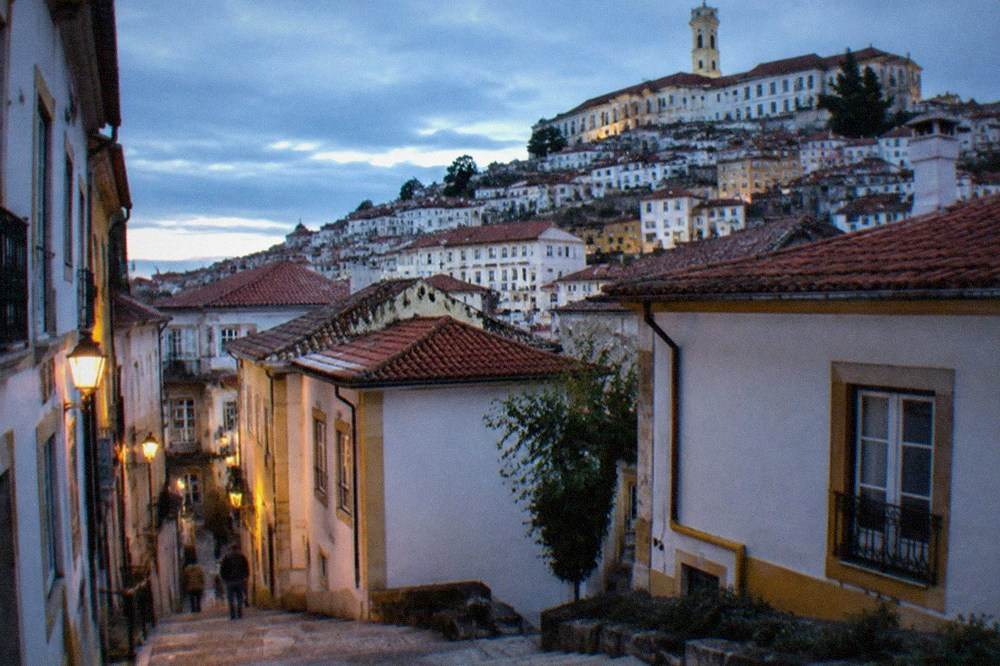
The practical consequence of Coimbra's shape is verticality. The Alta, the upper town, and the Baixa, the lower town, are connected by steep lanes and stairways, and a visit involves real climbing between the two. The University's summer schedule runs 09:00 to 20:00 from 1 April to 30 September and 09:00 to 17:30 in winter, so the hill is a full-day proposition in season. The student calendar matters too: the University closes its visitor circuit on 24 May, and Mosteiro de Santa Cruz suspends visits on the Cortejo da Queima das Fitas, a moveable Sunday, which means festival season can close monuments even as it fills the streets.
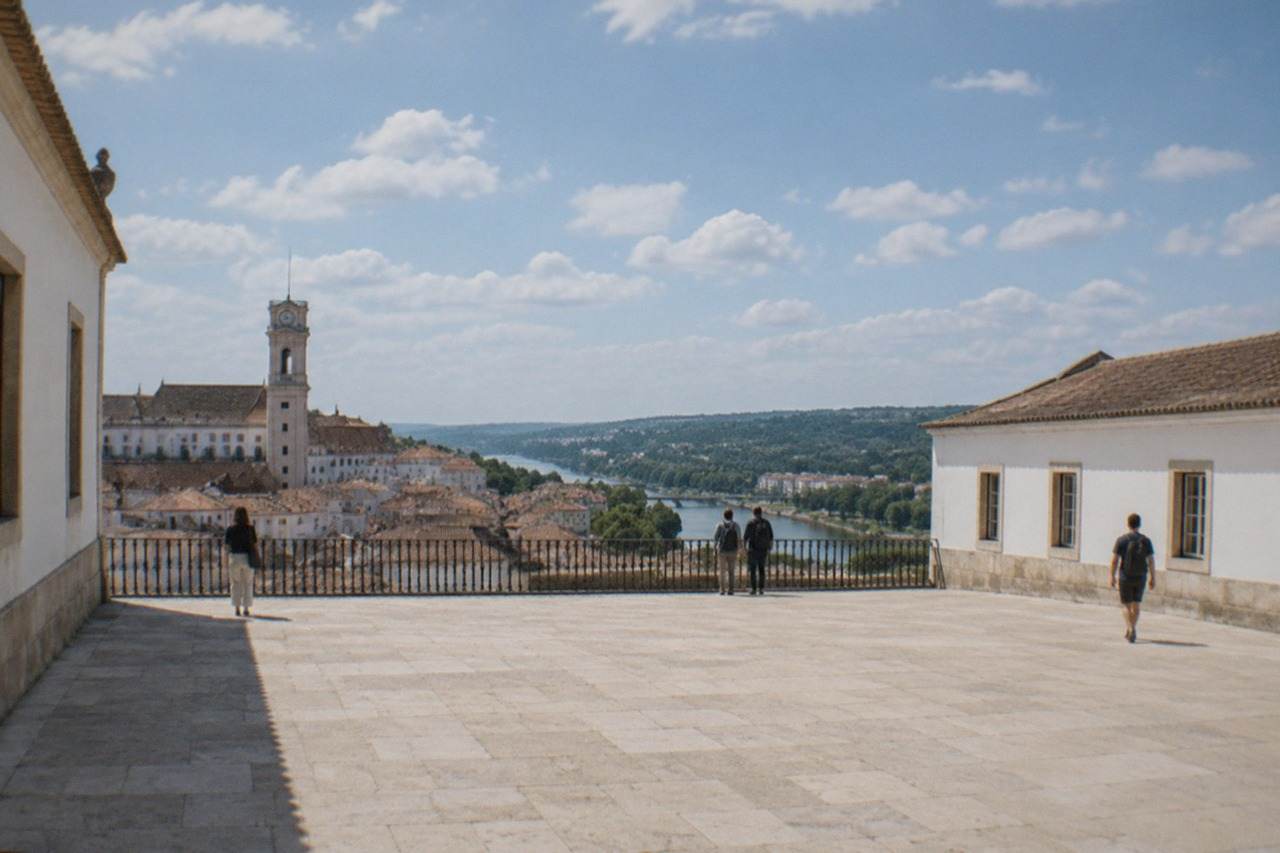
Évora, by contrast, is a place most visitors experience on foot in a flat loop: the Roman temple, the main square, the cathedral, the university church, all within a few minutes of one another inside the walls. The trade is that Coimbra's layered geography gives it views, from the university hill down over the red roofs to the Mondego, that a plateau town cannot match.
For atmosphere, the honest summary is this: Coimbra feels like a city that happens to have a famous monument at its top, and Évora feels like a monument that happens to have a town around it. If you want restaurants, nightlife and a student crowd, Coimbra has more of that. If you want quiet evenings in a small walled centre, Évora does.
A good way to absorb Coimbra's two-level geography quickly is a guided walk. The Coimbra Top Attractions Walking Tour runs two and a half hours from $5.85 per person and is rated 5 from 151 reviews on the operator's live listing, and a walk is genuinely useful here because the route from the Baixa up to the Paço das Escolas is easy to fumble without a guide. For a deeper look at how the city stacks up against other northern and central contenders, see Coimbra vs Braga and Coimbra vs Aveiro.
What Are the Must-See Sights in Each City?
Coimbra's headline sights are the Biblioteca Joanina, the baroque library that admits 50 people every 20 minutes and can only be visited on the University's 16.50 EUR combined ticket, plus the Sé Velha at 3.00 EUR and Mosteiro de Santa Cruz at 5.00 EUR. Évora's headline sights are its Roman temple, its cathedral and its walled centre, all seen on foot in a compact loop, and this site has verified no entry prices for any of them, so treat any figure you read elsewhere with caution.
The Coimbra side is unusually well documented, because the University runs its own ticketing through visit.uc.pt. The 16.50 EUR adult ticket covers the Joanina Library, the Royal Palace, St Michael's Chapel, the Chemistry Laboratory, the Academic Museum, the Cabinet of Curiosities and the Mineral Gallery, and it is valid for two days except the Joanina slot, which is fixed. The time printed on the ticket is the library slot specifically, entry outside it is refused, and online purchase closes 20 minutes before the visit. That 50-per-20-minutes ceiling is the one genuine scarcity fact on this site: in summer, a visitor who arrives without a pre-booked slot can be turned away.
| Coimbra sight | Adult price | Source status |
|---|---|---|
| Biblioteca Joanina + University + Science Museum combined ticket | 16.50 EUR | University's own ticketing site, valid for 2026 |
| University + Science Museum (no Joanina) | 12.50 EUR | University's own ticketing site |
| Sé Velha de Coimbra | 3.00 EUR | Parish visitor site |
| Mosteiro de Santa Cruz | 5.00 EUR | Parish visitor site |
| Museu Nacional de Machado de Castro | Closed for conservation work | National museums portal |
| Mosteiro de Santa Clara-a-Velha | Closed for requalification works | No official visitor page currently |
| Torre da Universidade | Closed | University's own information page |
Two of those closures matter for planning. The Machado de Castro museum, built over a mid-1st-century Roman cryptoporticus, is shut for conservation work, and the University's own page states plainly that the clock tower is closed. A guide that sells you a tower climb is out of date.
Évora's sights need no ticketing table here, because no verified prices exist for them on this site. What the place is, is not in dispute: a Roman temple in the main square, a cathedral you can walk around and up, a church famous for its chapel of bones, and a university with historic cloisters. All of it sits inside walls you can trace on foot. The comparison at the level of sights is therefore simple: Coimbra offers one world-famous interior, the Joanina, plus a cluster of churches and museums around it, while Évora offers a wider spread of outdoor monuments with fewer single showpiece interiors.
If the Joanina is on your list, book the University ticket before you travel, because the fixed 20-minute slot is the one part of a Coimbra visit that cannot be improvised. The Joanina Library tickets guide and the University tickets guide walk through the exact tiers, and the sights and attractions guide covers everything beyond the hill.

How Much Does a Day in Each City Cost?
A sightseeing day in Coimbra costs a verified minimum of about 25 EUR per adult in entry fees at 2026 prices, combining the 16.50 EUR University ticket, the 3.00 EUR Sé Velha and the 5.00 EUR Santa Cruz, plus a 1.00 EUR per night municipal tourist tax paid to your accommodation, capped at three nights and charged from age 16. No equivalent verified price set exists for Évora on this site, so only the Coimbra side of a cost comparison can be stated with figures.
The tourist tax detail is worth having, because it is widely misreported. The current published rate is 1.00 EUR per guest per overnight stay, in force since 5 April 2023, charged all year with no low-season exclusion, payable directly to the accommodation at check-in or check-out, and capped at three consecutive nights per person. The municipality's own worked example: a couple staying seven nights pays 3.00 EUR each. In July 2026 the municipality's Executive approved a proposal to raise the tax to two euros, but until the municipal tax pages themselves say 2.00 EUR, the current rate remains one euro. Coimbra's own economic justification for that proposal is the genuinely interesting part: the municipality recorded 698,151 overnight stays in 2025 and estimates its cost per overnight stay at 3.49 EUR, so even the proposed tax sits below cost.
| Coimbra cost item | 2026 figure | Notes |
|---|---|---|
| University combined ticket with Joanina | 16.50 EUR | Timed Joanina slot, ticket valid two days |
| University ticket without Joanina | 12.50 EUR | Same spaces minus the library |
| Sé Velha individual entry | 3.00 EUR | Group rate 2.50 EUR for 10 or more |
| Mosteiro de Santa Cruz individual entry | 5.00 EUR | Groups of 12 or more pay 3.50 EUR |
| Tourist tax | 1.00 EUR per night | Max 3 nights, from age 16, paid at the accommodation |
| SMTUC bus ticket bought on board | 2.00 EUR | Pre-purchased trips cost 0.90 EUR in packs of 3 or more |
For Évora, the honest position is that this site publishes no entry prices, no meal prices and no tax rate, because none were verified from an official source. What can be said qualitatively: the Alentejo is generally talked of as a region of generous, inexpensive food and wine, and Évora is its capital of that reputation, but a guide that prints numbers without a source is guessing, and this one will not.
One more Coimbra figure helps frame the value question. The city's bus network, SMTUC, sells a pre-purchased trip at 0.90 EUR when bought in packs of three or more against 2.00 EUR on board, and the 2026 tariff marks those titles valid on the Metro Mondego network as well, so a visitor's bus ticket works on the new BRT system too. For trip budgeting generally, the trip costs guide covers the full picture.
Which City Has Better Weather, and When Should You Go?
Coimbra's climate is Atlantic-influenced and wetter than Évora's continental Alentejo climate: IPMA's 1991 to 2020 normals for the Coimbra / Bencanta station show August as the hottest month at a 29.1 C mean maximum, July as the driest at 8.9 mm of rain, and November as the wettest at 121.5 mm, while Évora, sitting inland and further south, is broadly hotter in summer and drier year-round, though this site has no verified Évora station data to print beside the Coimbra table.
The Coimbra numbers are official and worth reading closely, because two of them contradict what most guides say. September is hotter than June, 27.4 C mean maximum against 26.3 C, and wetter too, 49.9 mm against 26.0 mm. The real sourced point is that the autumn rain holds off until October, when the monthly total jumps to 114.5 mm. September is therefore the best-kept secret in the Coimbra calendar: the crowds have gone and the weather has not. August, not July, is the hottest month, averaging 10.9 days above 30 C, and the station's record maximum is 41.2 C from 7 August 2016.
| Month | Coimbra mean max | Coimbra rain mm | Days 30 C or more |
|---|---|---|---|
| March | 19.1 C | 75.4 | 0 |
| May | 23.3 C | 64.7 | 3.5 |
| June | 26.3 C | 26.0 | 6.2 |
| July | 28.5 C | 8.9 | 8.9 |
| August | 29.1 C | 14.8 | 10.9 |
| September | 27.4 C | 49.9 | 7.8 |
| October | 23.2 C | 114.5 | 2.0 |
| November | 18.0 C | 121.5 | 0 |
Évora's climate, without numbers, is the classic Alentejo pattern: hotter, drier summers where midday heat drives everything indoors, and cool but bright winters. The practical contrast is that Coimbra's weather is gentler in summer, thanks to the Atlantic influence reaching up the Mondego valley, while Évora's is more reliable in the shoulder seasons but punishing in July and August if you are not used to serious heat. Neither city has a beach: Coimbra's district reaches the Atlantic at Figueira da Foz, but the city itself does not touch the sea, and Évora is deep inland.
For timing a Coimbra visit around the verified data, the best time to visit guide and the weather guide break the calendar down month by month, and the month-by-month breakdown is the one to read before booking any summer Joanina slot, because a 30 C afternoon is a different proposition on the unshaded university hill.
How Easy Is It to Reach Coimbra and Évora?
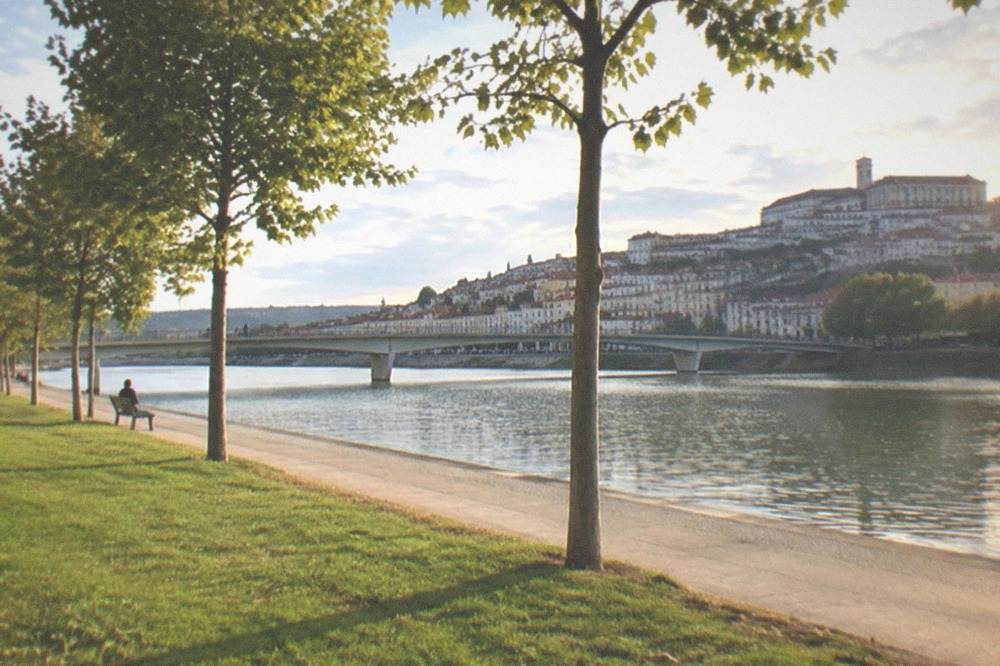
Coimbra sits directly on the Lisbon to Porto railway axis, with two stations, Coimbra-B and Coimbra-A, in different parts of the city, and CP, the national operator, is where to confirm which trains call where; Évora is reached by rail from Lisbon and lies well south, off the main coastal corridors, so the two cities suit different route shapes and a traveller doing both needs to plan a diagonal.
The two-station situation in Coimbra is a genuine trap and deserves precision. The stations exist, they are in different places, and their names are confusingly similar. This site does not publish which long-distance services call at which station, or whether the short connecting run between them is included in a long-distance ticket, because the national rail operator's site soft-404s station pages to automated checks and no official confirmation has been read. What a visitor should do is check CP's own passenger site for the specific train, and read the train stations A and B guide before booking. The Lisbon to Coimbra guide and the Porto to Coimbra guide cover the two main arrival corridors.
Within Coimbra, the SMTUC bus network covers the city, and the 2026 tariff confirms a pre-purchased trip at 0.90 EUR against 2.00 EUR bought on board, with titles valid on the Metro Mondego network as well. A new BRT system has been opening in stages since 2025, and the intermodal ticketing is the practical fact a visitor needs: your bus ticket works on it.
Évora's position is the mirror image. It is a southern city, reached by rail and road from Lisbon, and it is not on the way to anywhere else most visitors are going. That is either its weakness or its charm: you go to Évora deliberately, usually as part of an Alentejo loop, whereas Coimbra is a stop that falls into almost any central-Portugal itinerary by geography alone. If your trip is Lisbon to Porto by train, Coimbra is on the line. If your trip is Lisbon plus the Alentejo, Évora is the anchor and Coimbra is a detour.
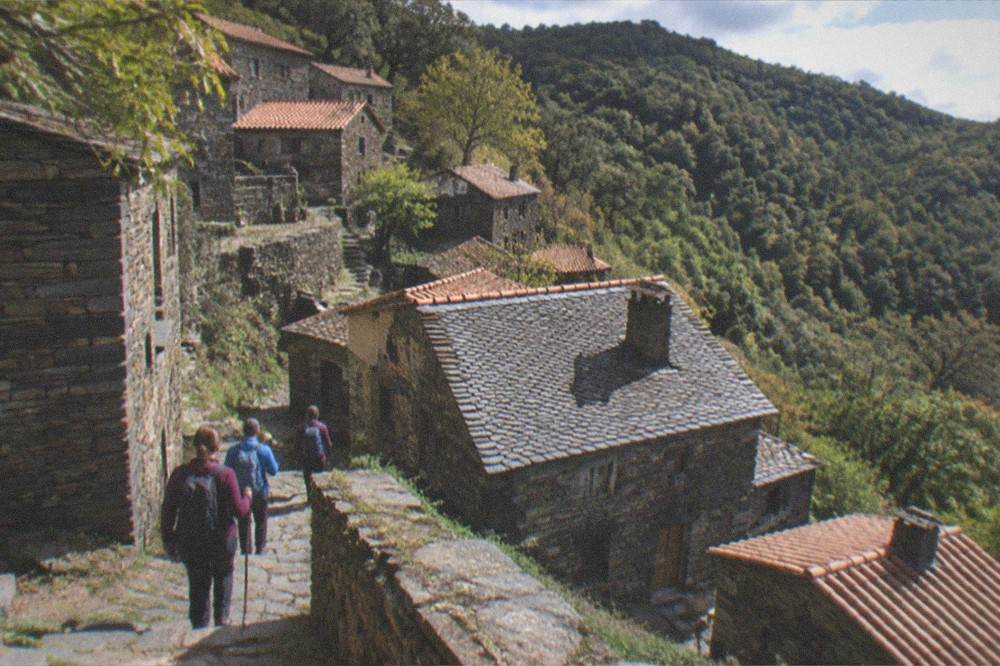
For travellers using Coimbra as a base rather than a stop, the surrounding region is stronger than many expect: the Roman ruins of Conímbriga about 16 km south in Condeixa-a-Nova, the schist villages of the Lousã mountain, and the Buçaco forest. The day trips guide lays out the options, and the comparison with another university-adjacent contender is covered in Coimbra vs Tomar.

What About Food: Coimbra or Évora?
Coimbra's verified food story centres on the city itself, the leitão da Bairrada tradition from the region to its west, and a student café culture in the historic centre, while Évora's is the Alentejo table, bread soups, slow pork and lamb dishes and strong regional wines, a reputation that is real but that this site cannot support with verified restaurant prices for either city.
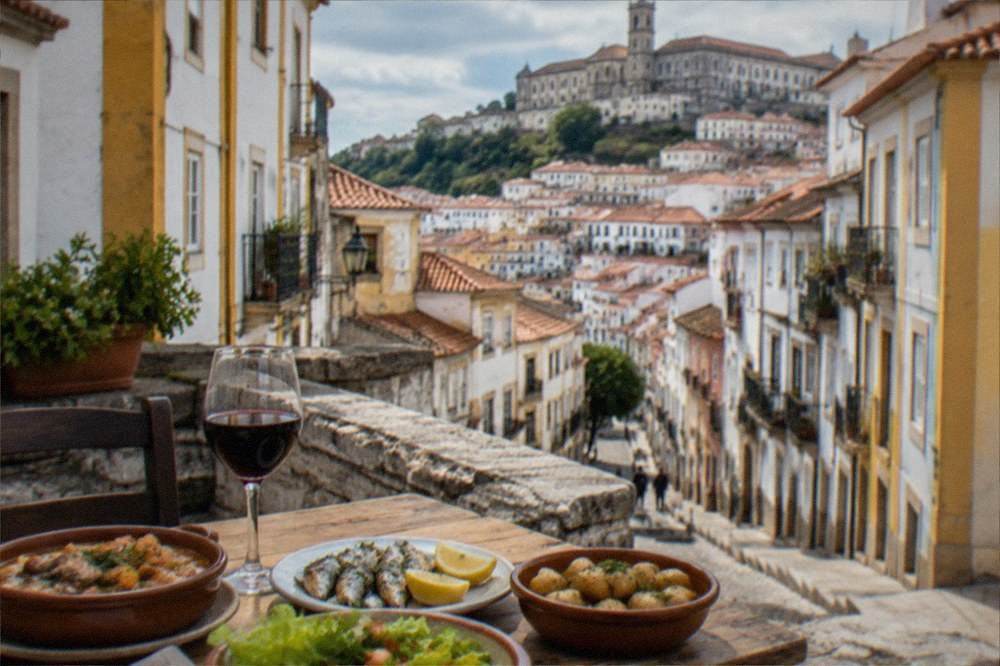
What can be written about Coimbra food with confidence is structural rather than numerical. The city is the historic gateway to the Bairrada region, whose roast suckling pig, leitão da Bairrada, is one of Portugal's most famous dishes, and the leitão and Bairrada guide covers where that tradition comes from and how to eat it. The restaurants guide and the best restaurants guide cover the city's own tables, and the student population guarantees a spread of cheap, busy places around the Baixa that a town of Évora's tourism-driven economy does not replicate in the same way.
Évora's food reputation needs no numbers to be stated fairly: the Alentejo is the region most Portuguese people name when asked where the country's most distinctive cooking comes from, and Évora is where most visitors taste it. Bread-based soups, herb-heavy pork dishes, sheep's cheese and full-bodied reds are the regional register. A fair comparison says Coimbra eats better as a student city, with more variety and lower everyday prices, while Évora eats better as a destination for a single long, regional dinner, and the honest traveller enjoys both for what they are.
Coimbra or Évora: Which Should You Actually Pick?
Pick Coimbra if your trip runs between Lisbon and Porto, if the Biblioteca Joanina and the university hill are the kind of sight you travel for, or if you want a city with nightlife, fado and student energy; pick Évora if you are building an Alentejo trip around slow food, serious heat and a walkable walled town, or if you have already seen Portugal's northern half. Splitting two or three days between both is possible by rail via Lisbon, but they are different trips in spirit.
The decision usually resolves on route. Coimbra is on the axis most first-time visitors travel; Évora is not. If time is short and the itinerary is the classic north-south run, Coimbra is the rational stop, and the is Coimbra worth visiting guide makes that case in detail. If the trip is Lisbon-centric and you want depth over breadth, Évora plus the Alentejo is a coherent week that Coimbra cannot join without a detour.
For Coimbra specifically, the strongest practical argument is concentration: the University's 16.50 EUR ticket covers seven spaces over two days, the Joanina's 50-people-per-20-minutes ceiling means the one unmissable interior is also the one that requires planning, and the city's own 2025 figure of 698,151 overnight stays tells you the crowds are real but the city is not yet saturated. September, hotter than June and drier than October, is the month the data points to.
Beyond the city itself, Coimbra's day-trip range is a real differentiator against Évora, whose excursions run to megalithic sites and wine estates in open country. From Coimbra you can reach the Conímbriga Roman ruins, where a combined museum and ruins ticket costs 10.00 EUR and the site is open seven days a week, making it the reliable Monday option when the state monuments that close on Mondays are shut. The Conímbriga guide covers it fully.
For something completely different, the schist villages of the Lousã mountain sit within easy reach of the city, and the soft canyoning trip on the River Ceira is the outdoor option in the region, a four-and-a-half-hour excursion from $58.54 per person, rated 4.9 from 79 reviews on the operator's listing. It is the kind of active half-day that a flat walled town cannot offer.
Common Questions About Coimbra vs Évora
Is Coimbra or Évora better for a short trip?
Coimbra is better if you are travelling between Lisbon and Porto, because it sits on the main rail axis and its headline sights, the University hill and the Biblioteca Joanina, can be seen in one full day. Évora suits a slower Alentejo itinerary. If you only have one day and you are already in central Portugal, Coimbra is the practical pick.
Is Coimbra a UNESCO World Heritage city?
No, and this is the most common error in guides to the city. The 2013 UNESCO inscription is called "University of Coimbra, Alta and Sofia", list reference 1387, and it covers two components inside the old town: the university hill and the college street. The city as a whole is not inscribed.
Which city is cheaper to visit?
Only Coimbra's costs can be stated with verified figures: a 16.50 EUR University combined ticket, a 3.00 EUR Sé Velha, a 5.00 EUR Santa Cruz, and a tourist tax of 1.00 EUR per night capped at three nights. This site has verified no Évora prices and will not guess. In general terms both are small inland cities and neither is expensive by Lisbon standards.
Can you visit both Coimbra and Évora on one trip?
Yes, by rail via Lisbon, though they sit on different corridors and the connection costs you most of a travel day. A common pattern is Coimbra on the Lisbon to Porto leg, then a separate loop south from Lisbon to Évora. Doing both properly needs at least five nights.
Which city has better weather?
Coimbra's verified normals show August as the hottest month at a 29.1 C mean maximum and November as the wettest at 121.5 mm, with September a quiet sweet spot. Évora, inland and further south, is broadly hotter and drier. If you dislike serious summer heat, Coimbra's Atlantic influence makes it the gentler of the two.
Do I need to book the Biblioteca Joanina in advance?
Yes. The library admits 50 people every 20 minutes, exists only inside the 16.50 EUR combined ticket, and the time printed on your ticket is the fixed entry slot. Entry outside the slot is refused, and online purchase closes 20 minutes before the visit time.
Both cities earn their place on a serious Portugal itinerary, and the choice between them says more about the shape of your trip than about the quality of either destination. Coimbra rewards the traveller who wants a monumental hill, a famous library and a student city's energy; Évora rewards the one who wants walls, heat and a long Alentejo dinner. If the rail axis decides it for you, Coimbra will be waiting on the way.