Is Coimbra Worth Visiting for Tourists?
Is Coimbra worth visiting for tourists? A source-checked answer covering the University of Coimbra, the Joanina Library's timed slots, real ticket prices, weather and the honest downsides.

Coimbra, Portugal, the university city on the River Mondego, earns its place on an itinerary through one hill. The University of Coimbra, with about 31,000 students according to the University's own published figures, sits above the old town, and UNESCO inscribed "University of Coimbra – Alta and Sofia" on the World Heritage list in 2013, criteria (ii), (iv) and (vi), list reference 1387. That inscription covers two components inside the old town, the university hill and the college street below, and not the whole city, which is a distinction most competing guides get wrong. The municipality's own figures, published on coimbra.pt on 21 July 2026, record 698,151 overnight stays in Coimbra in 2025, which tells you the verdict below is not a minority opinion held by a few romantics.
Is Coimbra Worth Visiting for Tourists?
Yes, Coimbra is worth visiting for tourists, and the reasons are specific rather than generic: a 2013 UNESCO World Heritage property built around a working university of about 31,000 students, the Biblioteca Joanina admitting only 50 people every 20 minutes, an adult combined ticket at 16.50 EUR, a one-euro tourist tax capped at three nights, and September weather that is warmer than June with half the crowds. It is not a beach city and it is hilly, so it suits walkers who want one concentrated, bookable day.
The honest framing is that Coimbra is a city with one extraordinary hill and a pleasant riverside below it. The University's own visit pages state that the Paço das Escolas circuit runs from 09:00 to 20:00 in summer and 09:00 to 17:30 in winter, and that the Joanina Library can only be seen inside the 16.50 EUR combined ticket, never on its own. The 50-per-20-minutes ceiling is the single most useful practical fact about the city: it is why a visitor who arrives in July without a pre-booked slot can be turned away from the library entirely.
That scarcity is also the argument for going. A place that manages its crown jewel down to fifty people at a time is a place you can still see rather than merely queue beside. The deeper answer to whether it is worth it depends on what kind of trip you are building, which the rest of this page breaks down with the actual numbers. For a fuller treatment, the site's guide to whether Coimbra is worth visiting goes deeper on the trade-offs.
What Makes Coimbra, Portugal Different from Other Portuguese Cities?
What makes Coimbra different is that its main monument is a living institution: the University of Coimbra publishes figures of about 31,000 students, 434 courses, 1,935 professors, 22 libraries and one botanic garden, and the tourist circuit runs through the middle of all of it. The UNESCO inscription of 2013 covers the university hill and Rua da Sofia, not the city as a whole, and the municipality's own 2025 data shows 698,151 overnight stays against an estimated municipal tourism cost of 3.49 EUR per stay.
The University's homepage is the source for those institutional numbers, and the page does not state an academic year, so treat them as current published figures rather than a pinned annual count. What they describe is a city whose identity is the institution. Student traditions, the black capas, the Repúblicas and the fado sung only by men in the old academic style, all come from the same place the tickets are sold.
The municipality's economic study, reported on 21 July 2026, is a figure almost no competing guide carries: Coimbra spent 1.94 million EUR directly on tourism in 2025, estimates its annual tourism cost at 2.44 million EUR, and puts the cost per overnight stay at 3.49 EUR against a tourist tax of 1.00 EUR. That is a city that has measured its own tourism rather than guessed at it.
Comparisons with other cities need care, because this build verified nothing for Porto, Lisbon, Braga, Évora, Tomar, Óbidos or Nazaré: no populations, no prices, no rankings. What can be said is factual about Coimbra itself. It is a compact, walkable, hill city with a river, and it is not on the coast. The district of Coimbra reaches the Atlantic, but the city does not touch the sea and has no beach. Readers weighing alternatives can see the site's answer on whether Coimbra is worth staying in.
What Does a Day in Coimbra Actually Cost?
A day in Coimbra costs 16.50 EUR for the full University circuit including the Joanina Library, 12.50 EUR without it, 3.00 EUR for the Sé Velha and 5.00 EUR for Mosteiro de Santa Cruz, plus a tourist tax of 1.00 EUR per night capped at three nights from age 16, paid to the accommodation. The University's prices are stamped valid for the whole of 2026, and the tax has been in force since 5 April 2023.
Those are the published, source-checked figures. The University's own program list prices the Joanina combined ticket at 16.50 EUR and the University plus Science Museum option at 12.50 EUR, both valid for two days except the fixed Joanina slot. The Unidade Pastoral Aeminium, which runs the two church monuments, lists the Sé Velha at 3.00 EUR and Santa Cruz at 5.00 EUR. The tax detail matters for budgeting: the municipality's own worked example says a couple staying seven nights pays 3.00 EUR each, 6.00 EUR total, and there is no exemption for business or study travel.
| Sight | Adult price | Source detail |
|---|---|---|
| Joanina Library + University + Science Museum | 16.50 EUR | Combined ticket, valid 2 days, Joanina slot fixed |
| University + Science Museum (no Joanina) | 12.50 EUR | Same spaces minus the library, valid 2 days |
| Guided Palace of Schools tour | 25.00 EUR | Guide-led, 1h30, Science Museum spaces excluded |
| Sé Velha de Coimbra | 3.00 EUR | Group rate 2.50 EUR for more than 10 people |
| Mosteiro de Santa Cruz | 5.00 EUR | Burial church of Portugal's first two kings |
| Tourist tax | 1.00 EUR per night | Max 3 nights per person, from age 16 |
Two closures change the arithmetic for 2026 and honest guides need to state them. The Museu Nacional de Machado de Castro is closed for conservation work, its own page says so, and its reopening price is unsourced, so the 10.00 EUR figure in circulation must not be printed as current. The Torre da Universidade is closed too, the University's information page states it plainly, so no tower climb exists to buy. Mosteiro de Santa Clara-a-Velha has been closed for requalification works since October 2025, and no official price or hours exist for it right now.
A walking tour is one way to compress the hill without doing the research yourself. The Coimbra Top Attractions Walking Tour runs 2 hours 30 minutes, is rated 5 from 151 reviews and starts from $5.85 per person on the operator's live listing, and the full tour page covers what it includes. Check availability
When Is the Best Time of Year to Visit Coimbra?
The best time to visit Coimbra is September, and the IPMA climate normals for the Coimbra / Bencanta station make the case with numbers: September's mean maximum of 27.4 C is higher than June's 26.3 C, it averages 7.8 days above 30 C, and it gets only 49.9 mm of rain against October's 114.5 mm. July is effectively dry at 8.9 mm, but the Joanina's 50-per-20-minutes slots make peak summer the hardest time to get in.
The IPMA normals, series 1991 to 2020, station 707, are the city's own measurements taken 3 km from the centre, not a coastal proxy from the district. Two things in that table surprise people. August, not July, is the hottest month, on both mean and mean maximum, averaging 10.9 days above 30 C, with the station's record maximum of 41.2 C set on 7 August 2016. And the autumn rain holds off until October, when the monthly total jumps from 49.9 mm to 114.5 mm; November is the wettest month at 121.5 mm. Other pages covering the same trip are gathered on Coimbra Travel Guide.
| Month | Mean max C | Rain mm | Days 25 C+ | The reading |
|---|---|---|---|---|
| May | 23.3 | 64.7 | 9.9 | Warm, green, before the summer rush |
| June | 26.3 | 26.0 | 17.8 | Dry and hot, crowds building |
| July | 28.5 | 8.9 | 26.1 | Effectively dry, hardest Joanina slots |
| September | 27.4 | 49.9 | 21.9 | Warmer than June, crowds gone |
| October | 23.2 | 114.5 | 9.9 | Rain arrives, roughly doubling |
| November | 18.0 | 121.5 | 0.7 | The wettest month of the year |
One timing trap belongs in every plan: the University closes its visitor circuit on 24 May, and Mosteiro de Santa Cruz suspends visits on the Cortejo da Queima das Fitas, a moveable Sunday, because the student parade takes over the streets. The festival falls in May, exact dates come from the Associação Académica, and a visit built around that weekend needs to expect closures rather than quiet. The site's answer on whether Coimbra is worth seeing adds more on timing.
What Are the Honest Downsides of Visiting Coimbra?
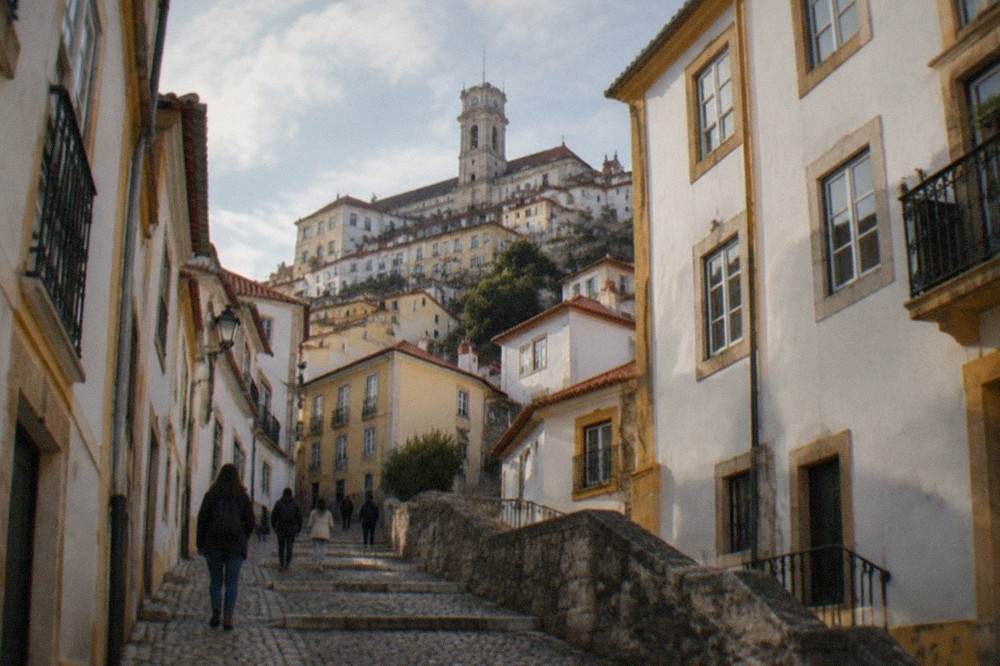
The honest downsides are three: the city is steep, with the university hill rising above the old town and no funicular price published for the Elevador do Mercado in the 2026 tariff; two major monuments, Machado de Castro and Santa Clara-a-Velha, are closed for works in 2026; and the Biblioteca Joanina's 50-per-20-minutes rule means no pre-booked slot equals no library. None of these sink the trip, but all three need planning rather than luck.
The hills are a real consideration, not a footnote. The old town climbs from the river to the Paço das Escolas, and the accessibility consequences are obvious, which the site covers in its page on what makes Coimbra special. The 2026 SMTUC tariff lists a driver ticket at 2.00 EUR and pre-purchased trips at 0.90 EUR each when bought in packs of three or more, valid 90 minutes on the urban network, and the same tariff states those titles are valid on the Metro Mondego network too, so the bus is the hill workaround. What the tariff does not give is a standalone Elevador do Mercado fare, so that number stays unpublished here.
The closures deserve a second mention because they are the most common disappointment. A visitor who has read an older guide will arrive expecting a museum and a monastery that are not currently openable. The museum's own page carries the closure line twice, which is unusual and deliberate, since a normal-looking hours table sits directly beneath it. The tower is the same story, with the University's own page stating the facility is closed.
The third downside is the one that can genuinely spoil a day. The Joanina slot is fixed, printed on the ticket, and entry outside it is refused, in the University's own wording. Online purchase closes 20 minutes before the visit time. Book the slot first, then build the day around it, not the other way round.
Is One Day Enough, or Should You Stay a Night in Coimbra?
One day is enough for the core of Coimbra: the University circuit is listed at three hours with the Joanina, the Sé Velha and Santa Cruz add another hour or two, and a fado show runs 50 minutes in the evening. Staying a night adds the fado, the riverside after dark and a calmer morning slot at the Joanina, and the tax argument for it is small, 1.00 EUR per night capped at three nights, so the decision is about time rather than money.
The practical sequencing favours the overnight, because the University's ticket is valid for two days except the fixed library slot. A visitor who books a late-afternoon Joanina slot on day one can use the rest of the ticket on day two without paying again. The fado show with a glass of port wine, rated 4.7 from 1,234 reviews and from $18 per person, is an evening product, which a day-trip schedule usually misses. The site's answers on whether it is worth staying a night in Coimbra and on how many days you need in Coimbra cover the pacing question directly.
For anyone with a second or third day, the surroundings earn it. Conímbriga, the Roman town about 16 km south in the parish of Condeixa-a-Velha in the municipality of Condeixa-a-Nova, charges 10.00 EUR for museum and ruins together and, unlike the DGPC monuments in the city, opens seven days a week, 10:00 to 18:00, which makes it the reliable Monday option. The site's answer on whether Conímbriga is worth visiting covers it, and a schist villages tour such as the Lousã options in the band below turns the hills from an obstacle into the destination.
The three walks above cover three different Coimbras: the city core on foot, the schist villages and cascades of the Lousã country, and the Roman layer at Conímbriga with the caves of Sicó. All three are operator-run, all three are bookable in advance, and the Conímbriga option pairs naturally with a Monday, when the city's DGPC monuments are shut and the ruins are open.
Common Questions About Visiting Coimbra
Is Coimbra worth visiting for tourists?
Yes. The University of Coimbra is a UNESCO World Heritage property inscribed in 2013, the Joanina Library is genuinely exceptional, and the published prices are modest: 16.50 EUR for the full combined ticket, 3.00 EUR for the Sé Velha, 5.00 EUR for Santa Cruz. The city recorded 698,151 overnight stays in 2025 according to the municipality, so the verdict is well tested.
Is Coimbra a UNESCO World Heritage city?
No, and this is the most common error in guides to the city. UNESCO inscribed "University of Coimbra – Alta and Sofia" in 2013, list reference 1387, covering two components inside the old town: the university hill and the college street. The city as a whole is not inscribed.
Can you visit the Biblioteca Joanina on its own?
No. The library exists only inside the 16.50 EUR combined ticket, admits 50 people every 20 minutes, and the time printed on the ticket is the library slot specifically. Entry outside that slot is refused, and online purchase closes 20 minutes before the visit time.
What is closed in Coimbra in 2026?
The Museu Nacional de Machado de Castro is closed for conservation work, the Torre da Universidade is closed, and Mosteiro de Santa Clara-a-Velha has been closed for requalification works since October 2025. The Sé Velha, Sé Nova, Santa Cruz and Portugal dos Pequenitos remain open.
How much is the tourist tax in Coimbra?
1.00 EUR per guest per overnight stay, capped at three consecutive nights, from age 16, paid to the accommodation at check-in or check-out. A two-euro rise was proposed by the municipality in July 2026 but is not yet the published rate, so budget on one euro.
What is the best month to visit Coimbra?
September, on the numbers. IPMA's 1991 to 2020 normals for the Coimbra / Bencanta station show a mean maximum of 27.4 C, warmer than June's 26.3 C, with only 49.9 mm of rain before the October jump to 114.5 mm. May is the alternative if you want green hills and cooler walking.
The verdict, weighed with sources rather than sentiment: Coimbra is worth visiting for tourists who want a concentrated, bookable, genuinely historic day, and it rewards an overnight with fado, an unhurried second morning and a two-day ticket already paid for.