Is Coimbra Portugal Walkable?
Is Coimbra Portugal walkable? Yes, the old town is compact and pedestrian-first, but the climb to the university hill is steep. Here is what to expect on foot and by bus.
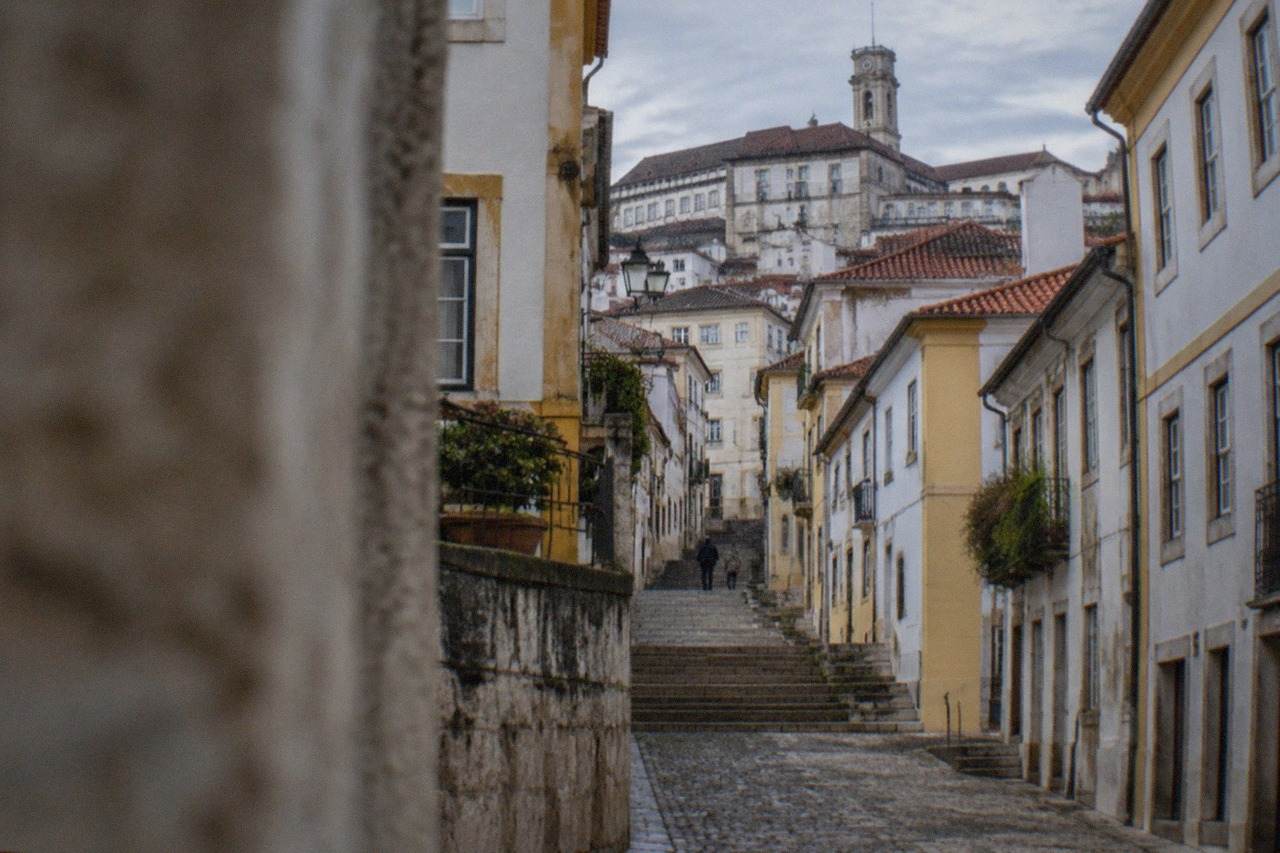
Coimbra, the university city on the River Mondego in central Portugal, is genuinely walkable, and that is not a marketing line: the two things most visitors come for, the university hill and the old town below it, are stacked almost vertically on top of each other, so a car buys you nothing except a parking problem. The Alta, the upper town, sits above the Baixa, the riverside low town, and the whole historic core between the river and the hill can be crossed on foot in well under half an hour. The one thing every walker should know before arriving is that the climb from the Baixa up to the Paço das Escolas, the university's palace square, is steep, cobbled and partly stepped, so comfortable shoes matter more here than in Portugal's flatter cities.
Is Coimbra Portugal Walkable?
Yes, Coimbra in Portugal is a walkable city, and one of the most walkable in the country. The historic centre is compact, the Baixa low town by the River Mondego and the Alta upper town with the university sit directly above one another, and almost every major monument, from the Sé Velha to the Mosteiro de Santa Cruz, lies within a short walk of the others. The one caveat is the hill: the ascent to the Paço das Escolas is steep and cobbled.
The layout explains why walking works so well here. Coimbra grew as a university city squeezed between the river and the hill, so the historic core never had room to sprawl. The Rua da Sofia colleges of the UNESCO-inscribed property run along the flat ground near the river, the Baixa's grid of shopping streets sits between them, and the university crown rises at the top. UNESCO's 2013 inscription, "University of Coimbra – Alta and Sofia", covers exactly these two components of the old town, the university hill and the college street, which tells you how concentrated the heritage is: the whole World Heritage property is a walkable district, not a region.
What that means practically is that a visitor can see the Joanina Library, the Capela de São Miguel, the Sé Velha, the Mosteiro de Santa Cruz and the riverfront in a single day on foot, with a bus or a rest only needed for the climb. The University's own visit pages state that the combined ticket covering the Joanina Library, the Royal Palace and the Science Museum spaces is valid for two days, which suits a walking pace: do the hill one day and the low town the next, or split the ticket's spaces across both.
The one number worth carrying in your head is the Joanina's entry ceiling. The University's own programme page limits entries to 50 people every 20 minutes, and the time printed on your ticket is the library slot specifically, not a general admission time. Entry outside the printed slot is refused. So on a walking itinerary, book the Joanina slot first and build the rest of the day around it, because the rest of the ticket's spaces can be visited before or after.
A guided walk is one way to handle the hill without thinking about the route. The Guided tour of the University and city of Coimbra covers both levels in two to three hours, from $84.29 per person, rated 4.9 from 399 reviews, and a local guide who knows the gentler staircases is worth having in a city where the shortest line on the map is often the steepest line on the ground.
How Steep Is the Climb to the University Hill in Coimbra?
The climb from the Baixa to the Paço das Escolas is short but genuinely steep, rising the full height of the old town in a few hundred metres of cobbled lanes and stone steps, and there is no flat route to the top. The University of Coimbra's own visitor pages describe the site as a hilltop palace complex, reached from the lower town on foot through narrow medieval streets. It is manageable for most walkers, but it rewards planning: comfortable shoes, water, and a slow pace.
The Alta was built on a hill because it was originally a fortified royal palace, the Paço das Escolas occupying the site of the former Royal Palace of Alcáçova, and medieval defensibility did not consult pedestrian comfort. The streets that lead up, including the lane through the Arco de Almedina, the old city gate, follow the medieval alignment, which means steps, uneven cobbles and gradients that push wheelchairs and small-wheeled luggage to their limits. Anyone asking whether Coimbra suits a walker should hear the honest answer: the flat riverside and the Baixa are easy, the hill is a real climb, and the two coexist in the same square kilometre.
Two practical notes from the verified record. First, the Torre da Universidade, the clock tower, is closed to public access: the University's own information page states the facility is closed, so no itinerary should include a tower climb. Second, the Museu Nacional de Machado de Castro, the museum that sits partway up the hill and is built over a mid-1st-century Roman cryptoporticus, is currently closed for conservation work, so the museum cannot be counted as a rest stop on the ascent. Check its official page before your visit for the reopening status.
The Museu Nacional de Conímbriga, by contrast, is open seven days a week, 10:00 to 18:00, but it is not in the city at all: the Roman site lies roughly 16 km south, in the parish of Condeixa-a-Velha in the municipality of Condeixa-a-Nova, so it is a bus or car trip, not a walk. Coimbra's walkability ends at the city boundary.
Can You Explore Coimbra Without a Car?
Yes, a car is unnecessary and often a liability in central Coimbra. The historic centre is pedestrian-first, the SMTUC city bus network covers the hills and the outer districts, and the 2026 SMTUC tariff shows a single ticket bought on board costs 2.00 EUR with pre-purchased trips at 0.90 EUR each, while a combined ticket valid on both SMTUC and the new Metro Mondego network exists. Parking in the old town is scarce, and the hills punish drivers more than walkers.
The 2026 SMTUC tariff, in force since 1 April 2026, is the document that makes car-free Coimbra work. A ticket bought from the driver costs 2.00 EUR, a pre-purchased pack of three or more trips works out at 0.90 EUR per trip, and each trip is valid 90 minutes on the urban network with transfers included within that window. The same tariff is explicitly headed as intermodal titles valid on both the SMTUC and Metro Mondego networks, so a bus ticket also works on the city's new BRT system that has been opening in stages since 2025. That single fact is the strongest car-free argument the city has: one ticket, two networks. More of these guides are collected on Coimbra Travel Guide.
| SMTUC ticket type | Price | Notes from the 2026 tariff |
|---|---|---|
| Single ticket bought on board | 2.00 EUR | Bought from the driver |
| Pre-purchased, 3 or more trips | 0.90 EUR per trip | Rechargeable card system |
| Trip validity | 90 minutes | Urban network, transfers included |
| MOVE-C support card | 3.00 EUR youth, 6.00 EUR others | One-off card cost |
| Viagem ConVIDA support card | 0.50 EUR | For occasional and pre-purchased tickets |
| Large-family 1-day ticket | 1.00 EUR | Covers 7 trips |
The Metro Mondego detail deserves its own sentence, because almost no competing guide has it right. The SMTUC 2026 tariff repeatedly marks its titles as valid on both networks, which is the verified, official statement that your bus ticket works on the Metrobus. What is not verified is any route map, station list or timetable for the new network, so check the operator's own site for the lines before relying on a specific stop.
One more car-free note: the Elevador do Mercado, the public lift that links the Baixa with the upper town, appears in the tariff under a combined-pass line with the Linha Azul, but the tariff gives it no standalone price, so confirm the fare with SMTUC before using it. Its existence is the useful part, since a mechanical link between the low and high town is exactly what a steep city needs.
For the university itself, a guided option removes both the route-finding and the queue thinking at once. The University of Coimbra guided tours without queue product includes tickets and runs in small groups, from $70.24 per person, rated 4.9 from 576 reviews, and the Joanina's 50-people-per-20-minutes ceiling is the reason a guided slot is worth money in this city: the library's capacity is a hard, published limit, and a tour that books the slot for you removes the single most common disappointment.
When Is the Best Weather for Walking in Coimbra?
The best walking months in Coimbra are May, June, September and early October, when the IPMA 1991 to 2020 normals for the Coimbra / Bencanta station show warm days and little rain: June averages a 26.3 C mean maximum with only 26 mm of rain, September averages 27.4 C with 49.9 mm, and July is effectively dry at 8.9 mm. Avoid the hill climb in the August heat, which averages 10.9 days above 30 C, and expect serious rain from October onward.
The climate table, read honestly, changes how you should plan a walking day. August is the hottest month, not July, on both the mean and the mean maximum, and its 10.9 days above 30 C make the steep, shadeless parts of the university climb genuinely unpleasant at midday. September is the quiet surprise: its mean maximum of 27.4 C is actually higher than June's 26.3 C, and it is wetter than June too, 49.9 mm against 26.0 mm, but the total is still modest and the student crowds return only late in the month. What a competing guide often gets backwards is the autumn: the rain does not arrive in September, it arrives in October, when the monthly total jumps to 114.5 mm, and November is the wettest month of all at 121.5 mm.
| Month | Mean max C | Rain mm | Days with 1 mm+ rain | Days above 30 C |
|---|---|---|---|---|
| May | 23.3 | 64.7 | 8.5 | 3.5 |
| June | 26.3 | 26.0 | 3.7 | 6.2 |
| July | 28.5 | 8.9 | 1.7 | 8.9 |
| August | 29.1 | 14.8 | 2.2 | 10.9 |
| September | 27.4 | 49.9 | 5.2 | 7.8 |
| October | 23.2 | 114.5 | 10.3 | 2.0 |
What Should Walkers Know About Coimbra's Seasonal Closures?
Walkers planning a route should know that Coimbra's two big current closures are the Museu Nacional de Machado de Castro, closed for conservation work, and the Mosteiro de Santa Clara-a-Velha, which has no listing on the national museums portal and has been closed for requalification works since October 2025. The University also closes its visitor circuit on 24 May and on 4 October, and Mosteiro de Santa Cruz suspends visits on the Cortejo da Queima das Fitas, a moveable Sunday in May.
These closures matter for a walking plan because the closed monuments are the ones a route would naturally include. The Machado de Castro sits directly on the hill route, and Santa Clara-a-Velha sits across the river, so a walker who arrives to find scaffolding has usually walked out of their way for it. The verified position on Santa Clara-a-Velha is deliberately cautious: the monument has no page at all on the national Museus e Monumentos portal, and dated Portuguese sources describe a full closure from 20 October 2025, so check before walking there, and do not trust a price or hours figure in circulation for it.
The May closure is a festival effect, and it is worth understanding rather than resenting. The Queima das Fitas, the student festival that fills the city each May, closes the University's visitor circuit on 24 May and suspends visits at Santa Cruz on the day of the Cortejo parade. Exact festival dates are published by the Associação Académica, and the University's own closure calendar is the reliable cross-check. A walking visitor in late May gets the most atmospheric week of the city's year, and also the week when the two headline monuments are hardest to enter.
The rest of the walking core stays open on a normal schedule. The Sé Velha charges 3.00 EUR for an individual visit, the Mosteiro de Santa Cruz charges 5.00 EUR, and the University's combined ticket with the Joanina Library is 16.50 EUR, valid two days, which is the one that rewards booking ahead because of the 50-people-per-20-minutes library ceiling.
For walkers who want a day off the city's hills entirely, the Schist Villages of Lousã Mountain half-day tour from Coimbra runs four hours from $99.51 per person, rated 4.8 from 45 reviews, and swaps cobbles for mountain villages in the Lousã range. It is a bus tour, not a walking tour, but the villages themselves are pedestrian places where the walking is gentle and the scenery is not urban.
Common Questions About Walking in Coimbra
Is Coimbra Portugal walkable?
Yes. The historic centre is compact, the Baixa and the university hill sit directly above one another, and the main monuments are all within a short walk of each other. The only real obstacle is the steep climb to the Paço das Escolas, which is cobbled and partly stepped.
Do you need a car in Coimbra?
No. SMTUC buses cover the hills and outer districts, a single on-board ticket costs 2.00 EUR in the 2026 tariff, and the same titles are valid on the Metro Mondego network. A car in the old town mostly buys you a parking problem on streets built for donkeys.
Is the walk up to the University of Coimbra difficult?
It is steep but short, a few hundred metres of cobbled lanes and steps from the Baixa to the Paço das Escolas. Most walkers manage it in ordinary shoes at an easy pace. There is no flat route to the top, and the clock tower itself is closed to visitors.
Can you walk along the River Mondego in Coimbra?
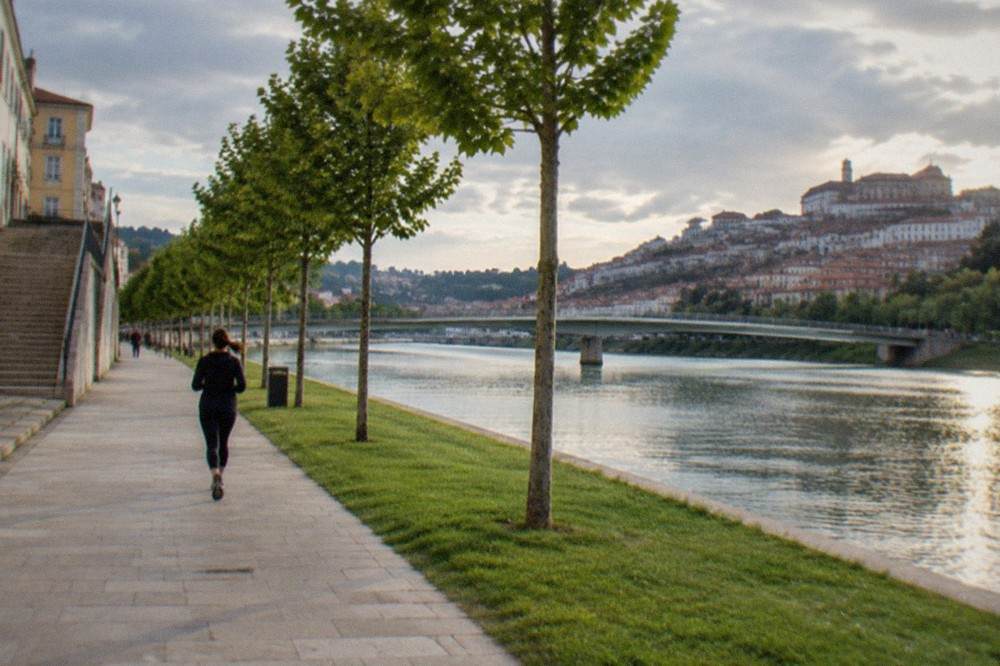
Yes, the riverside by the Parque Verde do Mondego is flat, which makes it the natural contrast to the hill: the low town and riverbank are the easy-walking part of the city, and the Alta is the part that earns your lunch.
Is Coimbra walkable for visitors with limited mobility?
Partly. The Baixa, the riverfront and the Rua da Sofia colleges are largely flat, but the university hill is stepped and cobbled throughout. The Elevador do Mercado links the low and upper town, though its standalone fare is not published in the 2026 tariff, so confirm with SMTUC before relying on it.
Coimbra rewards the walker more than almost any city in Portugal, and it does so precisely because its difficulty is concentrated in one honest hill rather than spread across a sprawl: plan the climb, book the Joanina slot, carry water in August, and the rest of the city simply unfolds underfoot. For more on planning around the city's layout, see what to see across Coimbra and how long to give the city in how many days you need in Coimbra, or start with the wider case in is Coimbra worth visiting for tourists.