What Is the Nicest City in Portugal?
Coimbra, Portugal, the university city on the River Mondego, has the strongest claim to being the country's nicest city. Here is the evidence, from UNESCO status to ticket prices and climate data.

Ask ten travellers what is the nicest city in Portugal and you will get ten answers, most of them built on postcards and hearsay. This page takes a different route. It argues for Coimbra, the university city on the River Mondego in central Portugal, and it argues only with facts that can be checked: a UNESCO inscription with a precise scope, published ticket prices, an official climate record, and the municipality's own tourism numbers. Coimbra is not the biggest Portuguese city, and this page will not pretend it is the most visited, because no such ranking has been measured. What it has is a concentration of history, living student tradition and riverside setting that few places anywhere can match, and the evidence for that claim is set out below.
What Is the Nicest City in Portugal?
On the evidence this page can verify, the nicest city in Portugal is Coimbra, the university city on the River Mondego, roughly midway between Porto and Lisbon. Its old town rises from the river to a hill crowned by one of the world's oldest universities, inscribed by UNESCO in 2013, and its streets are lived in by about 31,000 students whose traditions, black capes and fado give the city a character no other Portuguese place shares. The claim is not that Coimbra is the biggest or the most visited, because no body has measured that. The claim is that it offers the most distinctive combination of setting, history and living culture per square kilometre, and the sections below show the receipts.
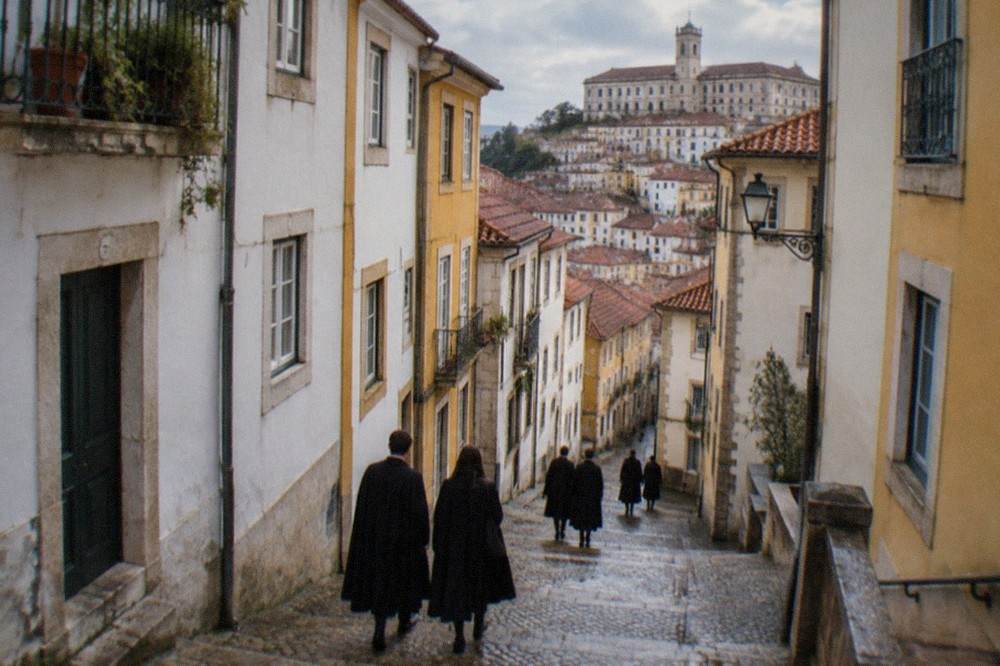
Every city in Portugal has churches. Coimbra's difference is that its monument is a working university, and the university shapes everything else. The University of Coimbra publishes a figure of 31,256 students on its own "University in Numbers" block, alongside 434 courses and 22 libraries. Those students fill the Repúblicas, the centuries-old shared student houses, sing a distinct fado that is sung only by men in black capes, and turn the month of May into the Queima das Fitas festival. The municipality's own figures show 698,151 overnight stays in Coimbra in 2025, which places the city firmly on the tourist map without drowning it.
The setting does the rest. The old town splits into the Alta, the university hill, and the Baixa, the riverside commercial quarter below, with the Mondego running past both. UNESCO inscribed "University of Coimbra – Alta and Sofia" on the World Heritage list in 2013 under criteria (ii), (iv) and (vi), covering the university hill and the college street of Rua da Sofia. Note the precision: the inscription is not the whole city, and any guide that calls Coimbra "a UNESCO World Heritage city" is wrong. The two inscribed components, however, are the two most beautiful parts of it.
What Makes Coimbra, Portugal Stand Out from Other Cities?
Coimbra's stand-out asset is the Biblioteca Joanina, a baroque library inside the Royal Palace whose entry is capped at 50 people every 20 minutes, a limit the University publishes on its own ticketing pages and one that no other Portuguese attraction matches for scarcity. The library cannot be bought as a standalone ticket at all: it exists only inside the 16.50 EUR combined ticket that also covers the Royal Palace, the Capela de São Miguel, the Chemistry Laboratory, the Academic Museum, the Cabinet of Curiosities and the Mineral Gallery. The time printed on that ticket is the Joanina slot specifically, entry outside the slot is refused, and the rest of the ticket stays valid for two days.
The library even has a resident bat colony, a fact the University's own space pages confirm, which protects the books by eating the insects that would damage them. That detail, a working 18th-century pest-control system inside a working 18th-century library, is the kind of thing that separates a city you photograph from a city you tell stories about.
Below the hill, the rest of the city holds its own. The Sé Velha de Coimbra, the Romanesque old cathedral, charges 3.00 EUR per person, published by the Unidade Pastoral Aeminium that runs it. The Mosteiro de Santa Cruz, burial church of Portugal's first two kings, charges 5.00 EUR. Conímbriga, one of the largest Roman town sites on the Iberian peninsula, sits about 16 km south in the parish of Condeixa-a-Velha, in the municipality of Condeixa-a-Nova, and its combined museum-and-ruins ticket costs 10.00 EUR with hours published seven days a week, which makes it the reliable Monday option when other monuments close. The Conímbriga ruins are worth the trip on their own, and a day combining them with the city is the standard two-day pattern.
Two honest caveats belong here, because a guide that hides closures is not a guide. The Torre da Universidade, the clock tower, is closed: the University's own information page states the facility is closed, so no tower climb should be planned. The Museu Nacional de Machado de Castro is closed for conservation work, and its reopening ticket price is not on any official page, so this site publishes no figure for it. The mid-1st-century Roman cryptoporticus beneath the museum is part of its route for when it reopens.
A city this compact rewards walking, and the terrain rewards planning: the climb from the Baixa to the Paço das Escolas is steep and short. The question of whether Coimbra is walkable has a short answer, which is yes, with calves. A private tour that ends with a late university visit solves the two problems at once, the hills and the timed Joanina slots, and the Best of Coimbra Private Walking Tour with University Late Visit is built exactly around that pairing.
How Does Coimbra Compare with Porto, Lisbon and Other Portuguese Cities?
Coimbra cannot be ranked against Porto, Lisbon, Braga, Évora or Tomar on any measured scale, because no official body publishes a "nicest city" ranking and this site verified no figures for those places, so the honest comparison is on what each city is: Coimbra is the student capital, built around a university founded centuries before Portugal had borders anything like today's, and it prices itself lower than the big two. Lisbon and Porto are far larger and far busier. Braga, Évora, Tomar and Óbidos are smaller and quieter. Coimbra sits in between, a real city with a real economic life that does not switch off when the tourists leave.
Where the pack does support numbers, they favour Coimbra on cost. The tourist tax is 1.00 EUR per guest per overnight stay, capped at three consecutive nights, payable to the accommodation, from age 16, in force since 5 April 2023. The municipality's own study puts its annual cost of tourism at 2.44 million EUR against those 698,151 overnight stays in 2025, a cost of 3.49 EUR per stay, so even the tax is priced below what the city spends on its visitors. A two-euro rise was proposed by the municipal executive on 21 July 2026, but until the municipality's own tax pages say two euros, the published rate remains one euro.
The university ticket anchors the sightseeing budget at 16.50 EUR for the full circuit including the Joanina, or 12.50 EUR without it. Add the Sé Velha at 3.00 EUR and Santa Cruz at 5.00 EUR, and a visitor sees the four principal monuments of the city for under 25 EUR in total entry fees, before a single meal. That is a defensible, sourced claim, and it is the kind of claim almost no competing "nicest city" article can make, because almost none of them cite anything.
When Is the Best Time to Visit Coimbra?
September is the best-kept secret in Coimbra's climate record: IPMA's 1991 to 2020 normals for the Coimbra / Bencanta station show a September mean maximum of 27.4 C, actually higher than June's 26.3 C, with only 49.9 mm of rain, while the crowds of summer have gone. August, not July, is the hottest month, averaging 10.9 days above 30 C, and the record maximum at the same station is 41.2 C, set on 7 August 2016. The autumn rain holds off until October, when the monthly total jumps to 114.5 mm, and November is the wettest month of the year at 121.5 mm, marginally ahead of October and January.
The full picture from the official normals, station 707, altitude 26.6 m:
| Month | Mean max C | Mean min C | Rain mm | Days 30 C+ |
|---|---|---|---|---|
| Jan | 15.0 | 5.2 | 113.5 | 0 |
| Feb | 16.4 | 5.5 | 81.0 | 0 |
| Mar | 19.1 | 7.8 | 75.4 | 0 |
| Apr | 20.5 | 9.4 | 84.6 | 0.7 |
| May | 23.3 | 11.8 | 64.7 | 3.5 |
| Jun | 26.3 | 14.2 | 26.0 | 6.2 |
| Jul | 28.5 | 15.6 | 8.9 | 8.9 |
| Aug | 29.1 | 15.7 | 14.8 | 10.9 |
| Sep | 27.4 | 14.1 | 49.9 | 7.8 |
| Oct | 23.2 | 11.9 | 114.5 | 2.0 |
| Nov | 18.0 | 8.3 | 121.5 | 0 |
| Dec | 15.6 | 6.2 | 111.3 | 0 |
July, at 8.9 mm of rain, is effectively dry, and July and August together give Coimbra a genuine hot summer, which is why the university's summer schedule runs 09:00 to 20:00 from 1 April to 30 September. May deserves its own note, and not for weather. The Queima das Fitas falls in May, and while the festival's exact dates are published by the Associação Académica each year rather than sitting in any fixed calendar, two closures are official and load-bearing: the University closes its visitor circuit on 24 May, and Mosteiro de Santa Cruz suspends visits on the Cortejo, a moveable Sunday. A visitor who hits the festival gets the city at its loudest and proudest, and a visitor who needs the monuments should check those dates first. More of these guides are collected on Coimbra Travel Guide.
What Does a Trip to Coimbra Actually Cost?
A two-day visit to Coimbra can be built on roughly 40 to 50 EUR per person in entry fees and local transport before food and lodging: the 16.50 EUR university ticket, 3.00 EUR at the Sé Velha, 5.00 EUR at Santa Cruz, 10.00 EUR at Conímbriga if you add the day trip, and SMTUC bus fares at 2.00 EUR bought on board or 0.90 EUR per trip when pre-purchased in packs of three or more. The tourist tax adds 1.00 EUR per night for up to three nights. Lodging and meals vary by season and are not published figures this site can price, so treat those as the variable part of the budget.
The verified fixed costs, all from the operators' own published pages:
| Item | Adult price | Source basis |
|---|---|---|
| University + Joanina Library + Science Museum | 16.50 EUR | University's own ticketing pages, valid for 2026 |
| University + Science Museum (no Joanina) | 12.50 EUR | University's own ticketing pages |
| Guided tour, Palace of Schools | 25.00 EUR | University's own programme list |
| Sé Velha de Coimbra | 3.00 EUR | Unidade Pastoral Aeminium |
| Mosteiro de Santa Cruz | 5.00 EUR | Unidade Pastoral Aeminium |
| Conímbriga museum + ruins | 10.00 EUR | National museum's own visiting page |
| SMTUC bus, driver ticket | 2.00 EUR | 2026 SMTUC tariff, in force from 01/04/2026 |
| Tourist tax | 1.00 EUR per night, max 3 nights | Municipal tax pages |
One more transport fact worth knowing, because it is genuinely unusual: the 2026 SMTUC tariff sells tickets marked valid on both the SMTUC bus network and the new Metro Mondego network, so a city bus ticket works on the Metrobus too. A Metro Mondego network has been opening in stages since 2025, and the tariff confirms the intermodal arrangement, but this site publishes no line map or station list for it, because none has been verified.
How Many Days do You Need in Coimbra?
Two days is the right answer for most visitors: one for the university hill, the Joanina Library, the Sé Velha and the old town, and one for the riverside, Santa Cruz, the Baixa and either a fado evening or a day trip to Conímbriga or the schist villages of the Lousã. The university ticket itself is valid for two days except the fixed Joanina slot, which is designed around exactly this rhythm. The full question of how many days you need in Coimbra has a longer answer, but the two-day pattern is the one the ticket structure itself assumes.
The Joanina's 50-people-per-20-minutes ceiling is the one genuine scarcity fact in the city, and it should shape the itinerary, not just the booking. Book the library slot first, build the day around it, and use the two-day validity to spread the rest of the university circuit across both mornings. An evening fado show with a glass of port wine, from $18 per person and rated 4.7 from 1,234 reviews on the operator's live listing, fits the first night; a half-day or four-hour tour into the Lousã schist villages or to Conímbriga fits the second day. For travellers who want the city explained rather than just seen, the budget Coimbra Top Attractions Walking Tour, from $5.85 per person and rated 5 from 151 reviews, covers the core in two and a half hours.
For travellers who want the whole thing handled, a private option deserves a closer look. The Best of Coimbra Private Walking Tour with University Late Visit pairs a two to three hour walk through the old town with a late-visit slot at the university, from $81.95 per person and rated 4.8 from 72 reviews on the operator's live listing. It is the tour this page names as its related pick precisely because the late-visit structure matches the Joanina's timed-entry reality better than a standard morning slot does.
For a first visit that has to fit into a single day, the essentials of what to do in Coimbra compress to the Paço das Escolas, the Joanina, the Sé Velha, the Arco de Almedina and a walk down to the river. Anyone with a free evening and a willingness to let a local set the pace can also take a GuruWalk free tour: the Coimbra tour downtown, historic center, university and botanic garden, rated 4.91 from 662 reviews, is pay-what-you-want and runs about three hours. GuruWalk is named here because the walk is free or pay what you want, and the platform and the guru deserve the credit, not a price tag this site would invent.
Common Questions About the Nicest City in Portugal
What is the nicest city in Portugal?
On the evidence this page can verify, Coimbra, the university city on the River Mondego in central Portugal, makes the strongest case: a UNESCO-inscribed university hill, the Biblioteca Joanina capped at 50 visitors every 20 minutes, a living tradition of about 31,000 students, and entry fees that stack up to under 25 EUR for the four principal monuments. No official ranking of Portuguese cities exists, so any absolute claim beyond that would be invented.
Is Coimbra a UNESCO World Heritage city?
No, and this is the most common error in guides to the city. UNESCO inscribed "University of Coimbra – Alta and Sofia" in 2013, list reference 1387, covering two components: the university hill and the college street of Rua da Sofia. The rest of the city, including the Baixa and the riverside, is not inscribed.
Can you visit the Biblioteca Joanina on its own?
No. The library exists only inside the 16.50 EUR combined university ticket, and the time printed on the ticket is the Joanina entry slot specifically. Entry is limited to 50 people every 20 minutes, entry outside the printed slot is refused, and online purchase closes 20 minutes before the visit time.
How much is the tourist tax in Coimbra?
1.00 EUR per guest per overnight stay, capped at three consecutive nights, from age 16, paid directly to the accommodation. It has been in force since 5 April 2023. A two-euro rise was proposed by the municipal executive in July 2026, but the published rate remains one euro until the municipality's own tax pages change.
What is the best month to visit Coimbra?
September, on the official climate record. IPMA's 1991 to 2020 normals for the Coimbra / Bencanta station show September with a mean maximum of 27.4 C, higher than June's 26.3 C, and only 49.9 mm of rain, with the autumn rain holding off until October, when the total jumps to 114.5 mm. July, at 8.9 mm, is the driest month if heat is not a concern.
Is Coimbra worth staying in overnight?
Yes, and the two-day structure of the university ticket assumes it: the 16.50 EUR ticket is valid for two days except the fixed Joanina slot. The municipality recorded 698,151 overnight stays in 2025, so the hotel base is established, and the tourist tax adds only 1.00 EUR per night for up to three nights.
The honest verdict, then: nobody has measured the nicest city in Portugal, and anybody who claims otherwise is guessing out loud. What can be said with sources is that Coimbra, Portugal packs a UNESCO-inscribed university hill, a baroque library guarded by bats and a 50-person entry ceiling, the tombs of Portugal's first two kings, a student tradition you can hear in the fado, and a September that the official climate record says is warmer than June, into a city you can walk across in half an hour. That is a case, and it is checkable, which is more than most answers to this question can say.