Is Coimbra Closer to Porto or Lisbon?
Coimbra, Portugal sits between Porto and Lisbon on the main rail line, and Porto is the nearer of the two. Here is how the stations, trains and day trips actually work.

Coimbra, the university city on the River Mondego in central Portugal, sits between the country's two largest cities, and the short answer to the question is Porto. Coimbra is the capital of its own district, not a suburb of either metropolis, and it has no airport of its own, so almost every visitor arrives by train, by bus or by car along the main north-south corridor that links Lisbon and Porto. Geographically and by rail, Coimbra belongs to the northern half of that corridor. This site does not publish a kilometre figure or a driving time for either run, because no official source for one was verified, but the practical structure of the journey is not in doubt: both cities connect to Coimbra directly, and the balance of convenience favours Porto.
Is Coimbra Closer to Porto or Lisbon?
Coimbra is closer to Porto than to Lisbon. The city stands in Portugal's Centro region, north of the geographic midpoint of the Lisbon to Porto corridor, and every published rail timetable reaches Coimbra from Porto sooner than from Lisbon. This site publishes no kilometre or driving-time figure for either run, because no official source was verified for one, but the ordering is not controversial: Porto first, Lisbon second, and both reachable in a single day by train.
That answer comes with an honesty note that most guides skip. The figures that circulate for these runs, roughly 120 km from Porto and 200 km from Lisbon, were checked during this site's research pass and could not be confirmed from an official source, and a distance-calculator website is not an acceptable citation here. So instead of printing a number this page will not stand behind, it gives you the things that are actually verified and the things that actually decide your trip.
What is verified, on the Coimbra side, is the arrival structure. Long-distance and intercity trains serve Coimbra-B, the city's main rail station, while a second station, Coimbra-A, sits closer to the historic centre. The two have confusingly similar names and they are in different places, which is the single most common arrival mistake in this city. The question of which trains call at which station, and whether the short connecting run between them is included with a long-distance ticket, is one this site deliberately does not answer, because the national operator's own pages could not be confirmed to say it. The operator, CP, is where that answer has to come from, checked against the timetable for your specific date.
The decision that actually matters is not the kilometre count. It is whether you are treating Coimbra as a day trip or as a destination, and which city your flight lands in. Both Porto and Lisbon work as origins, and the rest of this page lays out how each one plays out.
Where do Trains from Porto and Lisbon Stop in Coimbra?
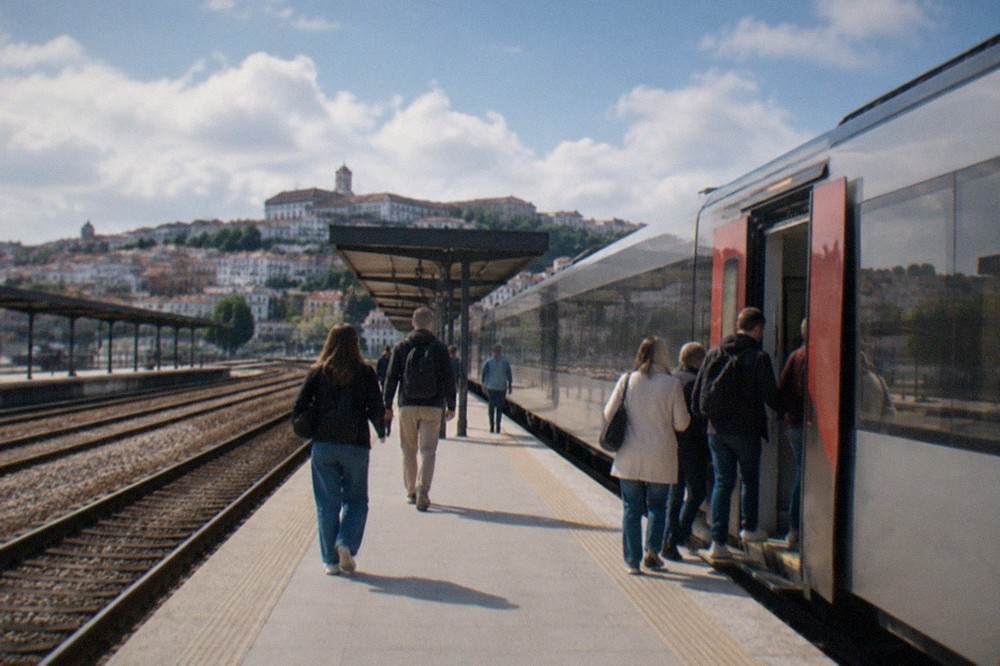
Every rail arrival into Coimbra lands at one of two stations: Coimbra-B, the main long-distance and intercity station, or Coimbra-A, the station closer to the city centre and the historic core. The two stations exist, they are in different places, and confusing them is the classic first-hour mistake in this city. Which services call at which station, and whether a connection between the two is included in your ticket, must be checked with CP, the national operator, for your specific journey.
The B station is the one that long-distance services use. If you are coming from Porto or from Lisbon on a fast train, B is where you should expect to step off. The A station is the one that sits nearer the Baixa, the riverside low town, and the climb up to the university hill, so it is the more convenient one to arrive at if your accommodation is central and your legs are ready for the hills.
| Station | Role on the network | Where it sits | What to check before travel |
|---|---|---|---|
| Coimbra-B | Main station for long-distance and intercity services | On the edge of the city, away from the historic core | Whether your specific train calls at B only, and how to complete the journey to the centre |
| Coimbra-A | Serves more local and urban connections | Closer to the city centre and the old town | Whether your ticket covers a connection, and the timetable for your date |
What this site will not do is fill that table with invented specifics. The distance between the two stations, the journey time of any connecting service, and above all whether that connection is free with a long-distance ticket: none of that could be confirmed from the operator's own pages during research, and this site's rules say a number that is not sourced does not go on the page. CP's passenger site is the place to check, and the check takes two minutes once you have your travel date.
Once you are off the train, the city itself is compact and steep. The university hill, the Baixa and the riverside are all within walking distance of each other, and the local SMTUC bus network covers the climbs for anyone who would rather save their knees. The 2026 SMTUC tariff lists a driver-bought single at 2.00 EUR and pre-purchased trips at 0.90 EUR each when bought in packs of three or more, with each single valid for 90 minutes on the urban network including transfers. Those tickets are also valid on the new Metro Mondego network, which is opening in stages, so a bus ticket is a broader ticket than it looks.
For the full arrival picture, including how the two stations compare in practice, see the site's dedicated guide to Coimbra's A and B train stations, and for the run from the north, the Porto to Coimbra guide covers it in detail.
Can You Day-Trip to Coimbra from Porto or from Lisbon?
Yes, from both. Coimbra works as a day trip by train from Porto and from Lisbon, and this site treats both as established day-trip routes with full itineraries. The difference is one of pace rather than possibility: the Porto run is the shorter leg of the two, which leaves more of your day inside Coimbra itself, while the Lisbon run consumes more of the day in transit and rewards an early start. Neither run requires a car.
The day-trip question is really a question about the Biblioteca Joanina. The University's own visit pages state that the baroque library admits 50 people every 20 minutes, that the time printed on your ticket is the library slot specifically, and that entry outside that slot is refused. The library cannot be bought on its own at all: it exists only inside the 16.50 EUR combined ticket, which also covers the Royal Palace, St Michael's Chapel and the science collections, and which is valid for two days except for the fixed library slot. A day tripper who arrives without a pre-booked slot in high season can be turned away at the library door, and that is the single fact that should shape any day trip from either city.
That constraint is also the strongest argument for the organised option. A guided tour with tickets included removes the slot risk, because the operator books the library time and the group goes in together. For the Porto origin, the site's day trip from Porto itinerary sketches the shape of the day, and for the Lisbon origin the matching day trip from Lisbon itinerary does the same.
The related tour on this page is built for exactly this decision. The full-day trip from Porto pairs Coimbra with Aveiro and a boat ride, it runs about a full day, and the listing rates it 4.7 from 106 reviews. You can read the site's own page for the Porto, Coimbra and Aveiro full-day trip or check the operator's live listing directly.
What Makes Coimbra Worth the Journey from Either City?
Coimbra rewards the trip with the University of Coimbra, whose Alta and Sofia quarters were inscribed by UNESCO in 2013 under list reference 1387, and with the Biblioteca Joanina, the baroque library that admits 50 people every 20 minutes behind a 16.50 EUR combined ticket. The University publishes a student body of about 31,000, and the municipality recorded 698,151 overnight stays in 2025, its own figure for the municipality. This is a working university city, not a museum piece.
Start with the correction that matters. Coimbra is not a UNESCO World Heritage city, and guides that say so are wrong. What UNESCO inscribed in 2013 is "University of Coimbra, Alta and Sofia", two components inside the old town: the university hill with its Royal Palace, St Michael's Chapel and Joanine Library, and the college street of Rua da Sofia below. The Baixa, the riverside and the rest of the city carry no inscription at all. The distinction is not pedantry, it tells you where to spend your hours: the hill and the college street are the recognised core.
| Verified Coimbra fact | Figure | Source level |
|---|---|---|
| University of Coimbra students | about 31,000 | The University's own published numbers |
| Joanina Library entry ceiling | 50 people every 20 minutes | The University's own visit pages |
| Combined UC ticket including the Joanina | 16.50 EUR adult | visit.uc.pt, stamped valid for 2026 |
| Municipal overnight stays, 2025 | 698,151 | The municipality's own figures |
| Municipal tourist tax | 1.00 EUR per night, max 3 nights, from age 16 | The municipality's tax pages |
Two of those figures deserve a line of explanation. The tourist tax is 1.00 EUR per guest per overnight stay, capped at three consecutive nights, payable from age 16, and it is paid to your accommodation at check-in or check-out, not to any platform. A two-euro rate was approved as a proposal by the municipal executive in July 2026, but until the municipality's own tax pages say two euros, the published rate is one euro. The overnight-stay figure comes from the municipality's own economic justification for that proposed rise, which also estimates the municipal cost of tourism at 3.49 EUR per overnight stay, a rare case of a city publishing the arithmetic behind its own tax.
Beyond the university hill, the city runs downhill through the Baixa to the Mondego. The Sé Velha charges 3.00 EUR for an individual visit, the Mosteiro de Santa Cruz, burial church of Portugal's first two kings, charges 5.00 EUR, and the Museu Nacional de Machado de Castro is closed for conservation work, so plan around it. Conímbriga, the Roman town about 16 km south in Condeixa-a-Nova, charges 10.00 EUR for a combined museum and ruins ticket and opens seven days a week, which makes it the reliable Monday option when other monuments shut.
For everything the city holds beyond the hill, the site's Coimbra attractions guide is the full inventory, and the question of what not to miss in Coimbra has its own answer page.
Which Tours Fit the Porto or Lisbon Origin Best?
For a Porto origin, the strongest fits are the full-day Coimbra and Aveiro trip with a boat ride, rated 4.7 from 106 reviews, and the private Fátima and Coimbra day trip from Porto, rated 4.7 from 37 reviews. For a Lisbon origin, the Convent of Christ tour in Tomar, rated 5 from 80 reviews, pairs well with Coimbra because Tomar sits on the same corridor. Every price and rating here comes from the operator's live listing.
The logic is corridor logic. Coimbra sits on the line that links the two cities, so a day trip from either end can pick up a second stop on the way, and the best tours are built that way rather than as a there-and-back. From Porto, Aveiro and the Fátima sanctuary both sit within reach of the same day. From the Lisbon side, Tomar and its Convent of Christ are the natural pairing, and the two-hour guided tour of the convent, run by a local guide, is the reviewed option there.
If you would rather travel independently, the site's guide to reaching Coimbra from Porto sets out the rail options, and the comparison between the two cities is covered in the site's own Coimbra Travel Guide pages on where to stay and how long to spend.
Common Questions About Coimbra, Porto and Lisbon
Is Coimbra closer to Porto or Lisbon?
Coimbra is closer to Porto. The city sits in the Centro region, north of the midpoint of the Lisbon to Porto corridor, and rail timetables reach Coimbra from Porto sooner than from Lisbon. This site publishes no kilometre figure for either run, because no official source was verified, but the ordering is not in doubt.
Which Coimbra train station do trains from Porto and Lisbon use?
Long-distance and intercity services use Coimbra-B, the main station, while Coimbra-A sits closer to the historic centre. Which specific trains call at which station, and whether a connection between the two is included in your ticket, must be checked with CP, the national operator, for your travel date.
Can you visit Coimbra as a day trip from Porto?
Yes. Coimbra is an established day-trip destination from Porto by train, and this site carries a full day-trip itinerary for that route. The one planning essential is the Biblioteca Joanina: it admits 50 people every 20 minutes, the ticket time is the library slot, and entry outside the slot is refused, so book before you travel.
Can you visit Coimbra as a day trip from Lisbon?
Yes, though the Lisbon leg is the longer run and rewards an early start. The same Joanina constraint applies: the library exists only inside the 16.50 EUR combined ticket, and the slot printed on the ticket is fixed. The site's day trip from Lisbon itinerary covers the shape of the day.
Does Coimbra have an airport?
No. Coimbra has no airport of its own, so arrivals go by train, by bus or by car, normally from Porto or from Lisbon. The nearest-airport question has its own page on this site, and the practical answer is that both major airports work as gateways, with Porto the closer of the two.
Is Coimbra worth stopping at between Porto and Lisbon?
Yes, and the numbers back it. The University publishes about 31,000 students, UNESCO inscribed the university's Alta and Sofia quarters in 2013, and the municipality recorded 698,151 overnight stays in 2025. The city rewards at least a night, and the Joanina's 50-per-20-minutes slot rule makes a pre-booked ticket the single most important thing to arrange.
Whichever city you start from, the same rule holds: book the Joanina slot first, then build the day around it, because the library is the one thing in Coimbra that can say no to you at the door.